Doubling down on dumbing down on data

Did you hear the news?  17 million morons voted to leave the E.U. then in open-mouthed stupidity wandered back to their computers to find out what they just voted for.  It’s true, because NPR + a graph proves it.

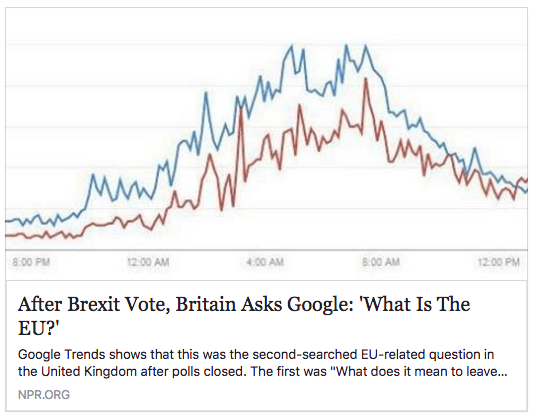
NPR should know better. They ran a story titled “After Brexit Vote, Britain Asks Google:  ‘What Is The EU?'”  It went viral on social media – with the predictable tut-tut, SMH, can you believe these people curations – and everywhere it was posted, you got the thumbnail:

Screenshot 2016-06-25 10.27.54

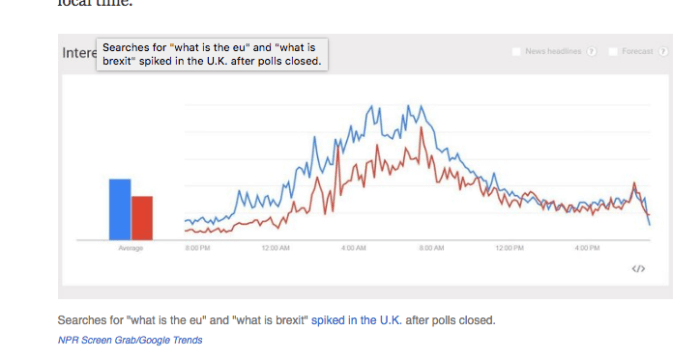
This is where data visualization needs a modern day George Orwell to kick some ass about the vicious cycle of sloppy visualizations and sloppy thinking.  By the way, if you’re inclined to say, “crops are always problematic, but they captured the story”, here’s the actual graph in the story:

Screenshot 2016-06-25 10.30.13

Once you’re done gasping at the steep upward climb, you might notice that the chart has no labels on the Y-axis, and no gauge for the volumes being measured.  Typically, Google Trends data is about the percentage of all searches that this search represents.  Just as typically, these trends are fractions of a percent – entire nations rarely run to the keyboard and run the same searches.  But we can’t know, because we were just shown graph lines.

What we do “know” from the “reporting” is that

“Though of course searches for these questions were dwarfed by the general interest in “Brexit results,” the question “what is the EU” spiked in popularity across all parts of the U.K., in this order: Northern Ireland, Wales, England, Scotland.”

This makes the reporting even shoddier:  the original numbers are small in comparison to these other numbers (which we also won’t quantify for you), but they definitely represent popularity spikes, and our keen political analysis formula is:

“Spike in popularity” == national mindset == gauge of political literacy

Therefore, our Breitbart-worthy headline, brought to you by the good people who sent you that coffee mug over which you just did that spit take.

What a terrible story and from NPR of all places.  I can only guess it’s targeted at people who need to freak out in their political microclimates.  Still, how is it possible, in the age of data literacy, that a real news outlet could run graphs without scale or labels on the Y-Axis? Or that millions of people could post it as if it proved anything?

 C’mon. Next time, keep my totebag and use the savings as an offset against the lost clickbait revenue.


Ways to Know You are Losing: You Sit on the House Floor all Night

The Democrats’ “historic” sit- in at the House of Representatives ended yesterday.  On the same day, Mitch McConnell used some arcane parliamentary procedure to prevent the Collins bill from moving forward in the senate. So, it looks like gun control is on hold until after November.  Or much longer. A few thoughts:

A lot of things have happened in the last eight years that I never thought I’d see in my lifetime. A black president, gay marriage, marijuana legal. So, I can’t give up hope that someday there will be a consensus on gun control, or at least control of assault weapons. And, that when it happens, it will happen all of a sudden and the NRA will never be the same.

But, I don’t think that sit-ins in the House are the answer, though I understand the frustration of the minority Democrats. It reminded me of the time Texas state legislators fled the state to deny the Republicans a quorum to prevent their passing a redistricting bill. It worked for a few weeks, but eventually, they all had to return to the legislature. And the Republicans passed their redistricting bill.

Ways to tell you are losing?  You have to flee the state to prevent a vote.  Or you stay up all night in the well of the House in an act of futile symbolism. Pelosi, Lewis, Rangel . . . All well into their seventies, at the end of long and honorable careers. In which they’ve been unable to change the debate on guns.

And, it does set a precedent. Imagine Trey Gowdy and Steve King doing the same thing on some issue important to conservatives.

I’m not optimistic that any meaningful assault weapons bans will be passed. But, if it happens, it will result from a mix of the following factors:

  • During the recent senate haggling over various gun control issues, Pat Toomey was shuttling between the NRA and Everytown, Bloomberg’s anti-gun organization, to work on language for legislation that he and Joe Manchin were authoring. Everytown’s potential to become a lobbying organization to counter the NRA is essential.
  • Sandyhook was clearly a transformative moment for the president, and the issue of gun control is likely to become a leading issue for him during his post-presidency. Obama + Everytown could change the equation, if they target specific congressional districts. Imagine Bloomberg’s money and Obama showing up in specific congressional districts to make the moral argument.
  • NRA members die. Demographics drive change. NRA members tend to be older and more rural. The number of hunters has declined precipitously in the last twenty years. At some point, guns just won’t be as potent an issue for a large enough segment of voters.
  • National Security. Orlando made gun control a national security issue. That should be a game changer. If the NRA can beat a National Security argument, then I tip my hat to them and will start pricing AR-50s.


Trump and Campaign Finance

Here’s something: a lefty post from the trenchant scholar Corey Robin on the provocative fact that mainstream proof of Trump’s unseriousness as a presidential candidate has now devolved on his lack of funds. The post is no defense or promotion of Trump: Robin is a close, critical student of conservative ideology from Burke to the Tea Party.  He’s noting how fundraising skills now equate, in traditional politics, with political competence:

I take it as a given that Trump is a con man and a grifter, who is more than likely in this just for the money (never underestimate the grifter’s appetite for the buck.) But notice what he is saying: I don’t need money to speak. I can communicate directly with the media. Not just communicate, but have an actual back and forth, where reporters get to ask me questions and I get to answer them.

And notice this journalist’s response to that claim: That kind of communication with the media is not the mark of a serious candidate in a democratic election. . .

More here.

Henry Hyde’s Epic Defense of Politics

Nothing more becomes a summer’s day than a speech on CSPAN-2 from the House of Representatives in 1995. But, if you care about politics even a little, then you need to set aside 12 minutes to view Henry Hyde’s impassioned and reasoned argument on the House floor in defense of politics as a profession, and politicians as practioners. And the importance of both in keeping a democracy vital.  Hyde’s message is important during a time when it’s easy to be contemptuous of government and the people who serve in it.

http://www.c-span.org/video/?c4524922/henry-hyde-term-limits

Hyde was a conservative Republican Representative from suburban Illinois. There’s very little in his political views that I agree with, but he was generally regarded by his colleagues on both sides of the aisle as one of the best representatives in the eighties and nineties.

Hyde’s speech is his argument against term limits for senators and representatives. Many readers may recall that term limits were a big issues in the 1990s. For a variety of reasons, very few incumbent senators or representatives lost their reelection bids during the second half of the eighties and first half of the nineties. Thus, the move to limit the number of terms that a senator or congressman could serve.

Hyde makes the case against term limits, but, even as that issue has faded into history, Hyde’s speech remains a stirring defense of politics and the people who practice it.   Some of his main themes:

There are about two dozen of Hyde’s colleagues in attendance, evidence of the importance of the speech and their respect for Hyde.  Keep an eye out for some interesting cameos. There’s Independent Socialist Bernie Sanders.  Behind him Bill Richardson.  Close ups on David Obey and the legendary Henry P. Gonzalez.

To belabor the point, at a time when respect for the profession of politics and the skill and dedication of the people who practice it are at an all-time low. At a time when we have Trump. Hyde’s message resonates—or should–more than ever.

Laska Scoops Matt Breunig on Mark Schmitt on Bernie Sanders

In an earlier post, Laska dissented point-by-point from Mark Schmitt’s op ed dissing Sanders’s progressivism as outdated. Now Matt Breunig  and Jacobin follow Laska and IatEotW with a related piece. (Breunig is probably too young to recall the Windows 95 launch.)

Rudderless and Rankled Republicans

More chaos stemming from a party with Donald Trump as its leader.  The once respectable, respectful, and honorable McCain, in yet another tight race for his political life, blames Orlando on POTUS, then tries to backtrack it blaming it on his actions.

More interesting, and representative of the challenges Republicans will face of real issues is the clip of Sessions trying to pre-empt the upcoming vote.

http://www.nbcnews.com/widget/video-embed/707162179881


At 1:54, Sessions tries to turn the no-fly ban on gun purchases into a big government issue:  “you can’t just have a secret list prepared by secret people that denies somebody a Constitutional right to keep and bear arms.”  Not sure how else a Republican expects to wage the war on terrorists with public agencies and public operatives, and public lists of suspects – I would imagine the Democrats would love to hear that argument a lot more.

Sanders Endorsements Downticket

Don’t know if you guys have thoughts on this. It’s getting pushback, notably from liberal women, on my Twitter TL:

Tweet from Bernie:   No president can do it alone. That’s why I’m endorsing progressives Rep. and Rep. .

It’s said that Kaptur is anti-choice and anti-stem-cell research. Sanders’s absence from the filibuster is also noted.

I can see how some legit progressives are anti-abortion; I can see how joining in the filibuster might have backfired (ha). But I note a sort of dogged tone to this move, and I’m genuinely confused — once again — about tactics in the Sanders campaign at this weird, maybe unique moment, and how they and the overall message are landing with voters now.

Public Echo Chambers and Polarization

Some time during the last Presidential election, at a friend’s summer home, there was a classic Laska conversation – white, male, romantic about industrial economies, and defensive.  There were three of us:  the friend, a very successful, affluent businessman who had advanced beyond his working class family; the friend’s brother, an affable, genuine guy who stayed working class and struggled; and me, less affluent, undeniably privileged, from a professional family in a working class town, but also declasse from my father’s death just as I was entering my teens.  I like to think Orwell would have found it rich.

The brother expressed the simple sentiment that liberals think working class people are dumb (familiar theme from me, I know, but I think I’m going somewhere).  As evidence he mentioned Clinton’s famous campaign line, the last in the campaign haiku:  “It’s the economy, stupid.”  It had never occurred to me or my friend that this comment was directed at voters, or a campaign line, or could be construed as judgment of Republican voters.  I had always assumed that this was Clinton talking to Bush, Democratic politicians talking to Republican ones.  Short of that, or in addition, I would sometimes read, “stupid” as “duh” – do we really need to be reminded that the economy is the issue?  Duh!  It was a surprising demonstration of how insider talk could become part of a voter’s thought process.

Fast forward to a talk by one of the people who is credited with helping facilitate the Arab Spring, Wael Ghonim (more here).  Ghonim created the Facebook pages and, with the skills of a Google employee, helped create other tools that were at the center of the “We are all Khaled Saeed” spark behind the protests in Egypt.  He has since become an observer and critic of the digital civic space as he continues his activism.  One of his slides at his Personal Democracy Forum talk, was a revelation:

Ghonim

In the last 4 – 6 years, people concerned about politics and civic space have been unpacking algorithms, market forces, business models, and what they do to public discourse.  Ghonim’s argument – simple to the point of duh, but to me profound – is that likes and comments reflect engagement and are leading indicators of generating clicks and views, the profit engine of the social realm – and they are shaping our civic space more powerfully than we know.

On the left, Ghonim says lots of likes indicate an echo chamber.  In human terms, these are posts where like-minded people get together and say preach, pat each other on the back, and tut-tut people on the outside.   It can turn into “micro-climates of virtue” to use Thomas Frank’s phrase, or simply be a place where you feel sane when the world around you doesn’t get it.  But it is an echo chamber.

On the right side of the chart, Ghonim indicates thats loads of comments (with few likes) are usually signs of flame wars – people hashing out disagreements, trying to be heard, mildly trolling each other.  In the middle is the unprofitable space of productive discussions – low traffic, low clicks, low signal for monetization.  Facebook and social networks don’t make money on that middle, even though that middle is what a democracy needs.

All of that was very interesting, powerful even, but for this post, I want to look at the echo chamber.  Let’s go back to the “stupid” conversation above.  That thought process occurred because an echo chamber – what people were saying to each other, in code, and for reinforcement – was made public (this may be the first time a campaign’s inner working were so public during the campaign?).  The echo chamber, insider talk (and I realize I may be incorrectly conflating there) became, effectively an unintentional advertisement of the cause.  Subtle difference.  A paid commercial says loudly and widely “this is what we are”.  The indirect transmission of echo chamber talk says loudly and widely “this is what they are.”

From 2012, we have memeified, virally transmitted, echo chamber moments IRL or from the meatspace: the 47% comment from Romney; the “cling to their guns” moment from Obama.  Today, in the digital space, where some social graphs include a wide range of political friendships, we have public, and polarizing echo chambers that further divide and fragment our political conversations.  Picture echo chamber activity happening today on Facebook:

Screenshot 2016-06-16 10.14.30

Screenshot 2016-06-16 10.14.49

They’re being shared mostly because they are funny, not because they advance conversation.  They are essentially reassuring, grounding echo chamber bits.  People will put likes and laughs under them.  People will also start to put comments of frustration about why there isn’t progress on the issues and those comments will invariably turn into two minutes hate of the people on the other side.  When they don’t turn into flame wars, they are viewable, public echo chambers.  People on the other side, or people who are on your side, but culturally distant, will scan the energy, sarcasm, and judgment in the echo chamber made public, and now they’re polarized.  “This is what they are”… and they don’t think much of you.

Phew, that took a while, but I think there’s a there there that helps explain why 2016 is markedly different from 2012 and 2008, even though 2008 was the original Facebook election.  In our conversation about how votes are formed, in particular CVFD’s comment that simply liking someone has to come into play, these polarizing, public echo chambers are something new to account for.

 

Words, worn words, and what’s next for them

markschmitt
Mark Schmitt knows.

Mark Schmitt ran a generally muddled analysis of the Sanders campaign’s importance and the future of progressive politics today.  With “Sanders, the Windows 95 of Progressive Politics”, Schmitt kinda mucks up the piece right out of the gate.  Windows 95 was one of the most successful software programs in history by nearly every measure – a stable, inexpensive, GUI operating system with backward compatibility (sounds dull, but people lined up to buy it and many graph inflection points, sometimes known as hockey sticks or knees, ensued).  If his desire was to show the kids that he’s hip and knows that OSX is better than Windows, he should have picked one of the dud launches – 98, 2000, Vista – rather than the one that truly transformed the computing game for hundreds and hundreds of millions of people – when Macs were an expensive, failing niche product.

But not the point.  Though kinda, yeah, since he’s trying to make the case that Sanders – the person who gave political voice to Occupy, mobilized 12 million voters, raised stunning amounts of money from human beings, turned a protest or conscience campaign into a reform movement within the Democratic party, and revived issues once thought to be dead, impossible, or non-starters – I have to repeat here since that got long, he’s trying to argue that Sanders is actually holding back a burgeoning left/progressive agenda.

But the post is titled words, so here’s what weird and worn (Bold is, as it should be, Schmitt):

  • “What will a post-Sanders progressive agenda look like? The first stop will be the official party platform. But for all the work and squabbling that go into them, platforms have long been throwaway documents.” I appreciate the honesty – “write whatever you want! They’re just words, it’s junk anyway.  We’ll print ten thousand copies and then throw them out.” (If true, however, why isn’t this what Clintonites call a no-brainer?  Why bother fighting about the committee appointments and pissing Sanders supporters off?)
  • “He has never had the kind of influence with his colleagues that he found with the grass roots this year, in part because he never defined himself as a Democrat.” I’m surprised Schmitt didn’t try to be hip with “identify” instead of “define”. But Sanders did identify himself with the words independent and Democratic Socialist – which may have diminished his influence (an arguable proposition as almost reported by the Times, and quickly eroding based on his reception by the Senate today) but what does that have to do with his progressivism?
  • “progressive organizations such as the Roosevelt Institute have developed fairly complex visions for strengthening regulation of Wall Street… and reducing the overall “financialization” of the economy, Mr. Sanders continued to fixate on restoring the Glass-Steagall Act Lots of interesting words in here, but the phrase I like is “fairly complex” as if that’s a virtue.  Is reducing carbon emissions too simple?  Are progressive organizations complexifying things like reproductive rights?   (It gets weird here too in that Schmitt praises Elizabeth Warren as a true progressive, even though she is the co-sponsor of the Glass Steagall restoration act on which Sanders is fixated.)
  • “The real progressive agenda has moved well beyond that to focus on raising and strengthening capital requirements, or the amounts that banks are required to keep as cash or safe investments.” Here the argument style gets interesting.  The article refers to a progressive thing here, a progressive thing there, and then says there’s a “real progressive agenda” – which loves the regulatory intricacies of Dodd-Frank, and is actually meh about minimum wage (see next).
  • He calls out Sanders for focusing on minimum wage and neglecting the “gig” economy (“ZOMG, hey guys, this dude is totally hip to our situation!”)  “Ms. Warren” he tells us “has called for a new social contract under which “all workers — no matter when they work, where they work, who they work for, whether they pick tomatoes or build rocket ships — should have some basic protections and be able to build some economic security for themselves and their families.” This used to be done with unions, social security, COLA-driven minimum wages, a strong NLRB, workplace rights, and welfare programs – the kinds of things New Democrats were eager to liberate the party from (even Social Security if you believe Thomas Frank’s research).  I’m not sure why Sanders’s support of a $15 minimum wage isn’t considered progressive (or successful) or why it is discontinuous from the work of Elizabeth Warren (who also supported Fight for $15).  “Social contract” is another phrase that throws me here.  New Democrats have typically wanted to bypass social contracts and rights arguments in favor of market forces and education. (Do you guys buy that argument? Or do I need to work on that?)
  • “This difference is part of a larger gap between Mr. Sanders and other progressives in their approaches to economic inequality. Where Mr. Sanders talks about “redistribution” of wealth from “the billionaires” to the middle- and low-income classes through high tax rates, others, such as the economists at the Economic Policy Institute, have focused more on what is sometimes called “predistribution.”  I am familiar with this idea, both from EPI and from Robert Reich, Sanders’s most fervent supporter.  But to read this, you’d think pre-distribution was as prominent a concept in the public debate as “radical Islam.” Apparently, there’s a raging debate and groundswell of support for “pre-distribution” laws (“When do we want them? NOW!”) and Sanders derailed it all with his tedious talk about “income inequality”. (There’s a special irony here in that Schmitt takes Sanders to task for seeking non-viable outcomes like single-payer, but praises predistribution ideas such as “meaningful constraints on executive pay…making sure workers got a greater share of the profits, not only in the form of money, but also time, flexibility and predictable scheduling.” Cuz, yeah, that’ll be a breeze.)
  • “If elected, Hillary Clinton will either join this new progressive wave or will be nudged and challenged by it. As Mr. Sanders finally steps back, the next era can begin.”  If only Sanders hadn’t even run and just stayed in the Senate diddling and doodling, the Economic Policy Institute, Demos, Roosevelt Institute and others would be swarming the halls of Congress rewriting the bogus legislation that corporate lobbyists authored, Dodd-Frank regulations wouldn’t be stalled by an army of lawyers, and there would be a real revolution of white papers and conferences.  (Another irony in the piece is that Robert Reich, Schmitt’s old boss at The American Prospect, is speaking passionately about the need for people in the streets and movement building around big simple ideas to serve progressive, sorry “progressive”, ideas.)

So, why the rant?

  • Well, it’s the Times so I tend to think it’s less click-baity and prone to contrarian opinions to keep traffic – at least less prone.
  • Owning the word progressive and liberal is suddenly very important.  Here it’s basically anything certain think tanks and Elizabeth Warren like (unless Sanders also happens to like it).  I take heart that we no longer have to hide in shame about being liberal or progressive or even socialist (!?), but it’s a weird state of affairs when Dodd-Frank is progressive due to its complexity and minimum wage is anti-progressive because there are easier fights to win – like curbing executive pay.
  • There’s a strange, sterile definition of politics as beltway policy arguments, where the best arguments from the best thinkers win and where money and popular support don’t matter.
  • Weirdest of all, there’s the notion that millions of people turning out to vote, “a party full of young voters for whom “Glass-Steagall” is a big applause line“, and a completely citizen funded national campaign that changed the debate and the party – is actually a hindrance to a real progressive movement.

The world’s turned upside down.