Biden on stretch goals

I can’t help but  speculate about Biden’s comments today on HRC’s incrementalist style.  Asked about Clinton’s pragmatic approach to things, VPOTUS praised Sanders’s boldness:

“I like the idea of saying, ‘We can do much more,’ because we can. … I don’t think any Democrat’s ever won saying, ‘We can’t think that big—we ought to really downsize here because it’s not realistic.  C’mon man, this is the Democratic Party! I’m not part of the party that says, ‘Well, we can’t do it.”

Now this is interesting in itself, especially with recent reports that Obama had been dropping hints that it’s time to start circling the wagons for HRC.  It’s also an interesting rebuttal of the DLC’s message to the liberal wings of the party in the 90s when Biden had recently been Presidential material.

But the part that really struck me was:

“Presidents have always been told by really smart people: ‘Don’t push something that you can’t succeed in — it diminishes your power,’ I completely disagree with that proposition.”

Why the shift from campaigning style to how Presidents are counseled?  Here’s a thought:

A little over two weeks ago, Bill Clinton tussled angrily and publicly with some Black Lives Matter protestors over the damaging effects his landmark crime bill had on black communities.  To be fair WJScreenshot 2016-04-21 20.47.45C really regretted the incident, enough to “almost want to apologize.” During the exchange, WJC said he was told he would only gain needed Republican support mith much stronger measures(*), and he specifically names Joe Biden and Chuck Schumer as the ones who counseled him.  During the Brooklyn debate, HRC invoked Biden as well during her defense of her role/non-role in the legislation.
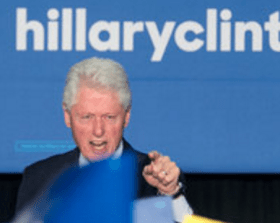
Is Biden getting out from under the Clintons’ attempts to rope him into the crime bill problem they can’t seem to put to bed?  Or is this just the usual lack of discipline? Could it be a planned/intentional attempt to have some impact on the party?

_________________________________

(*) I find it hard to understand what WJC wants us to think about his role in that bill.  Is he proud of it or not?  Is it a triumph  of his Presidency or the outcome of capitulating to Republican leadership?  What did he actually do that makes it his accomplishment?


Coronations

I forgot about this interview with DNC chair Debbie Wasserman Schultz.

I get it, Sanders didn’t like superdelegates going in.  Following the defeat in NY, he needs  a  credible  narrative to winning the nomination in order to justify continuing his campaign.  (It being his right, millions wanting to vote for him, or wanting to win delegates to influence the non-celebratory parts of the convention, isn’t enough.)  So now he talks about getting superdelegate support.

It’s messed up, yo. But let’s at least acknowledge that, to many in the party,  the primary season, is a coronation, not an election.

“Unpledged delegates exist really to make sure that party leaders and elected officials don’t have to be in a position where they are running against grass-roots activists.”

Love the internet.  Those rare moments when people say it like it is won’t go away.  And, with any luck, this one will get auto-tuned and mashed-up for more fun and views.

[Curious where you guys are on Kasich and Sanders staying in.  Do candidates have a responsibility to drop out?

Also, curious about the accepted wisdom that long, hard-fought primaries weaken a candidate.  I hear 1968 and 1980 as the examples – but did Dems lose because the nominating process was long?  Do we really know that was the problem?]

Harriet Tubman: Badass

My first response to Harriet Tubman being on the $20 bill was, ok, sure. Black. Woman. Check and check the diversity boxes.  Then I realized all I knew about her was her name.  And all we have, and will have, on the $20 bill is a nineteenth–century photo of an unsmiling old lady.

But, then I started to read about her. She was, of course, a slave. One time, a white man was pissed off at another slave and threw a two-pound weight at him. Missed him. Hit her.  Fractured her skull.  She was back in the fields two days later, still bleeding from her head.  She suffered epileptic-like seizers the rest of her life.

She made a daring escape from slavery. “Daring.” Like, there was any other kind of escape from slavery?  And, after that, she returned to slave-holding parts of Maryland, at enormous personal risk, to help other slaves escape to freedom on the Underground Railroad.  She carried a revolver and meant to use it.

There’s an about-to-be-famous woodcut image of her during the Civil War. In her forties.  Wearing what must have been a brightly colored head scarf and brandishing a rifle.  This image would have been explosive in 1963.  Or now.  But, in 1863 . . . .

This should be the image for the new twenty. Uniting both 14th Amendment and 2nd Amendment supporters in common cause.

In 1865, on a train in the North, the conductor asked her to move to a less desirable seat. A hundred years before Rosa Parks, she refused.  The conductor and two white passengers then wrestled her out of her seat and broke her arm in the process.

She helped lead Union troops in an armed assault on plantations along the Combahee River in South Carolina. An estimated seven hundred slaves broke and ran for freedom when they heard the steam whistles from the Union boats.  Broke and ran while their erstwhile masters vainly fired hand guns in the air and cracked bull whips.  And when the about-to-be-free slaves reached the Union boats they saw among the soldiers a black woman with a rifle. Badass.


What’s a primary for, really?

Now that Sanders has won a substantial number of delegates, is likely to win more, will sway some super-delegates, and stay in to the end, he’s getting more than a “seat at the table”.  He’s turning down the classic bargain:  gracefully drop out of the race, endorse the front-runner so s/he can rest up and get the balloon count right, in return for which the loser gets to make a speech and bask in cabinet appointment rumors.  One of the joys of voting for a cranky independent who’s too old (or even principled) to give a pizza rat’s slice about getting an appointment or a law firm job is watching him say “nope, you got nothing to make me stop, sorry, IMNA just keep exercising my right to win votes.  You’ll just have to staff out the balloon drop.  I’ll see you at the convention while you do that weird thing where you point at people in the crowd and smile and gesture and what not.”  Watching that happen will be pretty fun.

But the real joy is that Sanders is likely going to Philadelphia with a huge number of delegates, huge enough in fact to change not only the platform, but maybe, just maybe  . . . the rules of the nominating process.

The word revolution gets thrown around a lot.  Reagan staged one apparently, Bernie says he wants one.  When John Hodgman endorsed HRC, he made the case for incrementalism as a form of revolution, suggesting the only other kind involved barricades, blood, and guns.  I never took Sanders’s use of the word too literally, just that he was going to advocate fundamentally changing some things:  the financial system, money in politics, economic security as a right (not just a fortunate outcome of the free market) and . . . well, just that.

As Hodgman shows, when you get to the stage when you need pesky opponents to drop out, “revolution” is a word that lets you mock and belittle someone while appearing gentlemanly and sophisticated.  (Hodgman:  “Unless you want to have a REAL revolution, with shooting and stuff. You might. I do not.” Pity the Bernie Bro who wants to unpack and win that argument point for point.)

But here’s how the Sanders “revolution” is shaping up:  a cranky old man from a politically meaningless state builds (on) a movement, raises tons of money from human beings lacking in celebrity or power, proves that national campaigns can be successful without PACs, forces a major party to reckon with issues they’ve strategically ignored, and changes the rules to make the nomination process truly democratic and money-free.

Not the French, Russian, Chinese or American revolution.  Maybe not a revolution at all.  But it might just be revolutionary.


In at the End of the World

The three of us started this blog based on a correspondence we maintained throughout the late winter and early spring.  We were not only aghast at the rise of Trump and Cruz and the seeming collapse of the GOP at the presidential level, but also alarmed at what seems to be pending constitutional crises almost everywhere we look.  Thus, the title. Not quite the end of the world, but, maybe the end of many institutions and assumptions about government that we all take for granted.

We decided to move this conversation to a blog where friends and other interested observers could join in.  Would love to hear from Republicans as well as Democrats and even from a Trump supporter.

Old Hickory off the Double Sawbuck

Looks like a Broadway hit will keep Alexander Hamilton on the ten dollar bill.  And Andrew Jackson is getting bumped from the twenty.  There are many arguments to drop Jackson from the currency–mostly dealing with what we’d today call crimes against humanity  against Native Americans– but not least among them is that Jackson hated the idea of paper money.

His entire second term was dominated by a blood feud with Nicholas Biddle, president of the Second Bank of the United States.  Jackson’s contractionary monetary policy wrecked the economy shortly after he left office, making his hand-picked successor, Martin Van Buren, a one-term president.  I could make the case that if you don’t like Jackson, the worst thing you could do to him is leave him on the $20.