New Conspiracy Theory: Trump is good for Republicans

Pretend you’re a moderate McCain- or Poppy-Bush style Republican:

  1. Your party is infested with Tea Party, Freedom Caucus, and unyielding evangelicals.   You’re paralyzed.
  2. For eight years,  you’ve only seen them grow.  Your friends are losing their seats to  them, and you’re not sure you can keep winning.
  3. Your business friends are seriously worried – shutdowns, talk about defaults, none of that stuff is good for business.
  4. You conclude that you can’t reclaim the party in any meaningful time frame and that you need a new home to rebuild the base.
  5. Third party?  Oi, that’s a lot of work.
  6. Despair.
  7. But wait!
  8. Look! Across the aisle, a hawkish, pro-business candidate is about to take over the Democratic party!
  9. No, guys, seriously.  The new Democratic leader has always been malleable, has women locked up, and seems to get votes from blacks and Hispanics without having to give them anything.
  10. Forget abortion!  It’s more trouble than it’s worth as a wedge issue and we can’t count on the women in our lives or in our party to keep going along with us on that one.
  11. Seriously:  Let’s blow up this party with a maniacal candidate who will whip our fringes into a frenzy, then flip flop so much their heads will still be spinning by the time the inauguration rolls around.  They won’t realize all the money and structure is gone until the mid-terms.
  12. And boom! We take over the other party which is moving towards a center we’ve always liked.
  13. Seriously, there’s somebody here already asking for our money!  Let’s make a deal!

#micdrop

#boom

#tellmeimcrazierthantherealshitthatshappening

“It’s the economy, Clinton”

My head is spinning with this election.  So much acrimony, worry, infighting, delegate counting, rule tracking, score keeping of endorsements already hurt my brain.  And now we’re watching the Clintons re-stage the 1990s battle to win the angry white man … or … what?

Over the last couple days, HRC has been taken to task for her comments about putting coal miners out of business, apologized to a coal miner, started pursuing Republican donors, started pursuing alienated Republican voters, and asked her husband to ““come out of retirement and be in charge” of creating jobs in places that have been particularly hard hit.”

Despite Rob Reiner’s keen insight into the American electorate, pundits are finally acknowledging that Trump’s economic message is the more durable and, to HRC,  dangerously effective part of his candidacy.  (CVFD, would love to be pointed to Fallows intense and personal looks at Trump supporters.)  He can pull back on the anti-Hispanic stuff, spend less time on beheadings, and focus more on trade agreements, the decimation of the manufacturing sector, and both parties’ neglect of these parts of the economy.

As a result, we’re watching the weird theater of Trump telling the elite, technocratic Clinton of the day:  “it’s the economy, stupid.”  Oh, the irony.

So how is this all going to come together?  I think the Clintons (and now that Bill is out of retirement, I think I may just start saying that more regularly) are seeing a chance to build the biggest, broadest coalition the Democrats have ever had.  The long-awaited, oft-predicted collapse of the Republican party is finally upon us and everything but evangelical voters seem to be up for grabs.  HRC, running on fear of Trump, is looking at a virtual buffet of voting blocs:

Women + New Democrats + Sanders Supporters + Moderate Republicans + Economically anxious Republicans Voting for Trump + People of Color + Businesses of all sorts of sizes + the angry working man

It’s a dizzying possibility.  Racking up the biggest electoral map victory in recent years, quite possibly destroying the Republican’s legislative majority (numerically, or simply by dividing them), an almost impossibly disorganized opposition party, and an optimistic outlook for the 2018 elections.

Can Clinton make this coalition work?  Can Trump moderate himself with credibility or without losing his base?  Those are the bigger questions, but I want to focus on the economic outrage to which Trump and Sanders have given voice.

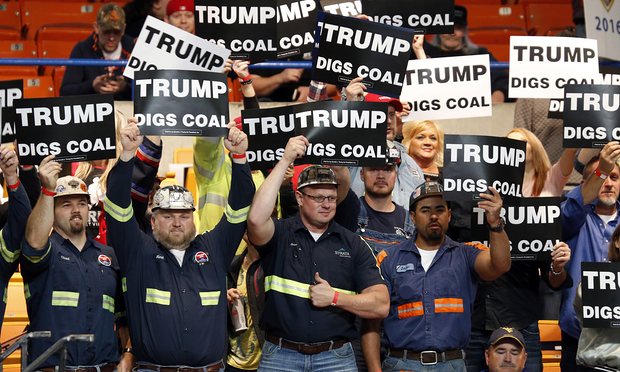
For Clinton, this picture in The Guardian today highlights the biggest threat:

Miners for Trump

I have my doubts that WJC can handle this.  For all his personal charm and his legendary ability to explain policy, he doesn’t seem to handle outrage well and he’s been pretty proud of his record on trade.   It’s one thing to explain how a policy will be good for you and gain trust.  WJC feels your pain, explains a complicated policy, promises it will be OK and we wipe tears from our eyes.  It’s an entirely different matter to convince people that their pain is completely unconnected to your policies, or that your really did help them while you were in office, and that your wife didn’t mean anything when she was so glib about miner’s jobs.

(And the subtext of the picture is that HRC’s coalition is decidedly not Bubba.  While HRC has smartly avoided the characterizations of the dumb, uneducated, overweight, incompletely toothed, unwashed, her supporters, in my experience have a hard time hiding their distaste and many just love crowing about their idiocy.)

It gets even trickier for the Clintons as they wade into this territory, because they could very well find themselves in the odd position of really needing active union support, rather than mere non-opposition.  Sanders has already proven that the rank-and-file membership are suspicious of New Democrat policies and are happy to ignore the endorsements of their national leadership (of whom they are also dubious). While I can’t imagine Trump ever earning the endorsement of the UMWA, I doubt we’re gonna see the legendary miners in camos at HRC rallies.

Which, to many Dems is the point:  “we were never going to win them anyway” but what about striking Verizon workers who saw Sanders walking picket?  What about the Teamsters who saw Elizabeth Warren go to bat for their pensions?  What happens when Trump starts beating the drum about HRC saying there was plenty of blame to go around for the recession including the irresponsible homeowners who took those mortgages?  Watching Trump versus WJC battle to be champions of the working man, the working poor, and the struggling middle class will be a great cosmic joke.  But it will also be terrifying, because Trump has a narrative and no record.  And the Clintons have a worn-out narrative and a highly questionable record.

Oi. Oi. Oi.

Conversation Starter #1: Is HRC tacking right already?

Since this started as a replacement to email threads, I’m resisting the urge to mail this and just making it a post:

What are we to make of HRC’s outreach to 1) Republican voters; and 2) Republican donors?

I think they’re separate questions, because I think Trump has proven that Republican voters can be mobilized around jobs and New Deal democratic issues.  But then I wonder, does the freeing up of moderate Republicans who can’t stand Trump mean the Clintons (since Big Bill is making what HRC termed a “comeback”) are going back to the old DLC playback?  (This gets doubly interesting when you layer in Schultz’s backtracking on how she plans to fill committee seats at the convention.)  Where does she need to tack to pull them in?  Can she pull in the Republican voters while keeping the Sanders voters?

The question about funding is the most worrisome.  All I’ve read so far is that HRC’s campaign “intends to reach out to Republican megadonors disillusioned by their party’s presumptive nominee.”  That could cover everyone from . . . well, a lot of disagreeable people.  Imagine what Trump will make of that . . . he’ll probably drop the word “whore” and not even bother to back away from it.

Happy to be pointed to links to do my own thinking, but I’m hesitant to express my fairly predictable misgivings yet.


Does the woman card help HRC?

There’s an old rule in advertising that you don’t respond directly to other people’s ads.  The thinking is simple:  they chose to say it, so why repeat it on your dime?  In political terms, we warn that you don’t let your opponent set the terms of the debate.  If they want to talk about it, you more than likely don’t.

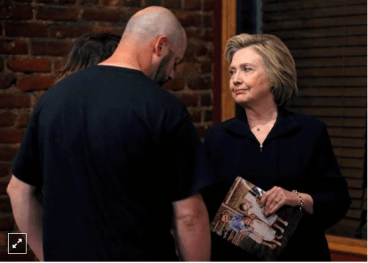
Screenshot 2016-05-04 09.03.41
Likely Democratic Presidential nominee Hillary Clinton giving a supporter a Woman Card.  (Ed:  Correction, this photo shows Mrs Clinton apologizing to a miner about her statement “We are going to put a lot of coal miners … out of business.”

HRC is getting a lot of play out of the woman card – offering “woman cards” to people who make donations.  She’s built the “deal me in” line to her recent speeches and seems to revel in delivering it, and her online ads have moved from red, white, and blue, to pink-ish and yellow with a universal symbol for the women’s rest room.  It’s a clever, well executed “campaign” as advertising types would call it.  But is it helping her?

I’m wondering if Trump, or his new staff, is clever enough to  have set a trap.  His very first words on the national stage (the first debate) were “I frankly don’t have time for total political correctness and to be honest with you, this country doesn’t have time either.”  Thunderous applause in the room, and it certainly hit a nerve for people who can’t pay their mortgages and don’t have time to worry about whether “he or she” is as offensive as simply saying he.  (See South Park episode “Sponsored Content”.  Seriously.  See it.)  After months of getting beaten up by the press but rewarded by voters for his comments about women, after watching the Fiorina ploy do nothing to hurt Trump, do we think he was stupid to play the woman card on HRC’s playing of the woman card?

Historically, the Clintons have always worked to distance themselves from special interests that smack of the 60s, the New Left, unions, undwomancardue deference to blacks.  Like it or not, WJC and HRC have both won over white centrists with strategic digs at these constituencies and stances against them (eg, DOMA).  At a time when Gloria Steinem and others are scolding women to vote on gender rather than economics, it might be that the one special interest the Clintons held onto – women – could become a liability if HRC plays it too hard.

It’s ironic to watch HRC not only walk into the space Trump has invited her, but to even venture into the true, scary flavor of “political correctness” where you have papers showing you adhere to the party line, and where there are fire and brimstone consequences for those who don’t toe the party line.  That’s a bit of an exaggeration, but might the cards and the tone be playing into the worst parts of PC and right into Trump’s hand?

What was really wrong about HRC’s coal comments

HRC took, and will likely to continue to take, some heat for saying “we are going to put a lot of coal miners and coal companies out of business.”  She later apologized to a protestor for the comment and explained herself.

This is HRC’s “you didn’t build that” or “cling to their guns” moment – a sentence taken out of context from a statement that was unarguably sympathetic to the people who will be protesting it.

To clear it up, the larger context of the line was that:  1) moving to clean energy needs to happen; 2) making that move will dislocate a lot of coal miners; and critically 3) we need policies to make sure that clean energy jobs replace the coal mining jobs in those areas.  If you don’t believe it, watch the full clip.

Did you watch it?  You need to, because the problem isn’t what she said, but very subtly how she said it, and how she phrased it.

There are many reasons people are deeply suspicious of the New Democrat/Clinton approach to income equality, economic opportunity, and growth in general.  One of the fairest is that the approach is too technocratic.  Clinton solutions (from husband, wife, or the Ivy League think tank) are typically:  more education, and market forces.  “Change is inevitable” as WJC reminded us during NAFTA and rather than fight it, or hold the line on certain issues in the face of it, we should re-train our workforce and nudge market forces with incentives (credits) and disincentives (taxes called something else).

To affluent voters who appreciate elegant solutions, took microeconomics,  and have (seemingly) unthreatened careers, this is yummy brain candy (“win-win-win”!). However, if you’ve got an education but are struggling, don’t put a lot of stock in micro-economic wizardry, and have no idea what’s in store for your profession, you’re suspicious of the fancy talk.  Break up the banks sounds clean and likely to work without hurting you.  Risk profiles on shadow banks sounds like “wha?” and maybe misdirection.  No more trade agreements which sends jobs overseas, hurray! Education grants, economic zones, change management policies . . . f*!# you.

If we assume that the Clinton/Schumer Dems are in fact committed to helping poor and working families, then “close your eyes and listen” to the clip again, or at least that fateful sentence:  “We are going to put a lot of coal miners and coal companies out of business.” I hear a proud technocrat: “we are going to do such a kick-ass job at clean energy, that we’re going to wipe out this industry.”  Wiping out fossil fuels is a good outcome, but the construction and delivery of the sentence borders on gleeful.  (There’s almost an exclamation point.)

Compare that construction to this:  “We need clean energy for a lot of reasons:  independence from foreign oil, public health, the water our children drink and the air they breathe, and protection of our environment.  But switching to clean energy is going to have the unintended consequence of dislocating coal miners and disrupting communities dependent on mining companies.  We need to ensure incomes for those people and communities who depend on coal.”

(I used “unintended consequences” because it’s already comfortable language for HRC.  More to the point, it highlights language that she could have used, knows how to use when talking about the crime bill, but didn’t use here – her technocratic side comes through.)  (I’m aware that there’s a tangential connection to clean energy and Flint, but, hey, play the game, right?)

This sounds like parsing, but the differences run deep.  Rather than putting people out of business (ha, look  how we crushed it!), you’re dislocating and disrupting  (“and that’s bad”).  It’s a very human-centered way of talking about  economic problems without being a wonk.

This is the kind of thing that scares me most about HRC in the general.  If she takes up the fight on income inequality and economic disruption, which I think she must, can she do it in a credible way that reaches humans and not just well-educated liberals?  Say what you will about Sanders’s lack of subtlety and Trump’s lack of substance, neither candidate leaves room about their belief in what they’re saying.

God, I hope she can pull this off.


What’s worth talking about on the Republican Side?

Seriously.  I’m trying to think of something that isn’t about some of the deeper threads in the Democratic Party, but I can’t think of anything to say about Trump or Cruz that isn’t old territory.

On a personal note, I like to try and unpack Trump support to prove it’s not all racists and xenophobes, but I’m kind of lost.  Happy to be pointed in a direction.

Filter Bubbling

I should put much more time into this – after all, there’s already a book and a symbiotic TED talk about filter bubbles, so it’s hard to make sure I’m adding value.  The (slight) difference is that this is about how people respond to filter bubbles with auto-filter-bubbling.

So first, definition work: filter bubble is a phrase coined (or popularized) by Eli Pariser, co-founder of both UpWorthy and MoveOn.org.  In its original form, it describes the way in which findability algorithms –  Google’s search, “Related content”, and “Similar to this” features all over the web – create feedback loops that serve people more of the content they’ve already been consuming.  This sounds great, even the purpose of the algorithm and the web, but it has the effect of keeping people from seeing more recent, topical, arguably more important content.  It’s a bubble created by algorithmic filters.

As I’ve mentioned, I’ve experienced filter bubbling on my social media in both parties’ primaries.  On the Democratic side, I see almost no Bernie Bro or Bernie or Bust obnoxiousness, and only see HRC supporters denouncing Sanders supporters for various forms of stupidity or misogyny.  On the Republican side, the internet gives me things that will tank Cruz’s, or Trump’s campaign today, right now, game over.

The Guardian ran a piece yesterday about a happy green acre of land on Reddit where people can laugh and give a collective sigh of relief at recognizing the insanity of Sanders spam.  Because Reddit, in the main, is young, unknowingly all-knowing, smug white males (ie, Bernie Bros), Reddit itself is the worst kind of political zealotry, zealotry with enough intelligence to convince yourself that it’s not zeal when you’re smart and rational.  When you’re almost Vulcan-like in your logic, it’s righteous, not zealous.  Neal Stephenson has a great line in Snow Crash about digerati men:

It was, of course, nothing more than sexism, the especially virulent type espoused by male techies who sincerely believe that they are too smart to be sexists.


Within Reddit, /r/Politics is just about the worst of the worst kind of Sanders zealotry.  Spend a couple hours there and you’ll see the “maddening invulnerability of the” smug.  On /r/Politics, when a Bernie Bro calls HRC a “bitch”, he’s not being sexist (because he’s not sexist!), he’s setting a trap about double standards in language use, being allowed to correctly use a word when needed, the ways in which HRC gets protection from criticism and on and on and on.

The happy place Reddit counter to /r/Politics is /r/enoughsandersspam.  I’ve only spent an hour there, which is like sampling an eyedropper of water on the Amazon, but that won’t stop me from saying this is an auto-filtering bubble by people too smart to generalize.  Most of the posts are better-natured than more zealous HRC folks. Words like “goofy”, “wha?”, and verbal eye rolls replace denunciations of traitorous, aggressive behavior.  It’s also highly therapeutic – a place to let off steam and say “ikr?” with like minded people, without getting too angry.

But it’s all still a denunciation of one annoying filter bubble with another filter bubble behavior.  And it’s there for good reason, to be sure.  The work of having debates, trying to defuse arguments, the desperate attempt to say “I’m not trying to change you, but do want to take on your characterization”, or simply avoid all that stuff for an hour can be quite stressful.

There’s a scene in Annie Hall, where Alvie goes to Annie’s apartment one night after they’ve broken up (to kill a spider, I think).  While he’s there he sees a copy of The National Review and freaks out.  She defends herself by mentioning that she wants to hear “other points of view”, which is a chance for a classic Woody Allen litany of all the insane anxiety-inducing things she could do next in search of other opinions.

I’ve recently fled to The Guardian, finding the NYT hard to stomach.  Have I found a place that keeps me alert to worthwhile “other points of view” and a balanced understanding of the world?  Or am I building another filter bubble?

________

I’ve always enjoyed playing the game of remembering quotes and comparing them to the real thing.  Nicholson Baker does it in U and I, with Updike quotes, so here’s the scene from Annie Hall.  I was right about the spider, wrong about the litany.

		ALVY
				 (Looking down at the magazine) 
			What is this?  What are you, since 
			when do you read the "National Review"?  
			What are you turning in to?

					ANNIE
				 (Turning to a nearby chair for 
				some gum in her pocketbook) 
			Well, I like to try to get all points 
			of view.

					ALVY 
			It's wonderful.  Then why don'tcha get 
			William F. Buckley to kill the spider?

					ANNIE
			 (Spinning around to face him) 
			Alvy, you're a little hostile, you 
			know that?  Not only that, you look 
			thin and tired.

She puts a piece of gum in her mouth.

					ALVY
			  Well, I was in be- It's three o'clock 
			in the morning.  You, uh, you got me 
			outta bed, I ran over here, I couldn't 
			get a taxi cab.  You said it was an 
			emergency, and I didn't ge- I ran up 
			the stairs.  Hell - I was a lot more 
			attractive when the evening began.  
			Look, uh, tell- Whatta you- Are you 
			going with a right-wing rock-and roll 
			star?  Is that possible?


Big Words and What They Mean

I’m pretty sure this is unique to this election, and I’m pretty sure this starts with Sanders…

This election has created a lot of social media-storms, Medium-storms, and just general small-time small talk about Very Big Words in politics and history.  In the last four months, ever since Sanders moved from protest candidate to a real pain in the party’s neck, the following words have been hotly debated chattered:

  • socialist – of course, because Sanders is a Democratic one, but few (myself included) bother to dig deep into what he means by it, or to understand the European flavor of the word.  I suspect there are three reactions:  1) distrust – from an association of socialism with bloody systems of state communism; 2) enthusiasm – from people who are leftists and know/believe socialism to be something more akin to Orwell’s definition of socialism as “common decency” and a critique of unfettered capitalism; and 3) code – simply a critique of capitalism, market forces harnessed for social outcomes.  (I skipped #4 hard-core socialists because I’m not sure that they – people who have read and thought deeply to find their tendency – take Sanders seriously as a socialist.  Chomsky doesn’t.)
  • revolution – I’m most surprised by how seriously this word is taken, and that it’s taken more seriously than socialist.  John Hodgman had a dickish smug liberal moment  in his endorsement of HRC when he wrote:  “Major change is ALWAYS incremental. Unless you want to have a REAL revolution, with shooting and stuff. You might. I do not.”(*)  To my mind, there are again different ways in which the word lands in people’s political minds:  1) revolution == big change, big enough to change the game;  2) revolution == upending the entire political order; and 3) revolution == something involving the execution of the ruling class (or the losing class).  I find it silly to address Sanders’s use of the word on any but the first.  Revolution for Sanders has meant taking money out of politics, re-distributing wealth, and putting societal requirements on an equal footing with capitalism.  All three of those things have been, until Occupy, heresies.  (Remember the grief Obama got when he told Joe the Plumber “we gotta spread [the wealth] around?)  So while they may not meet everyone’s definition of a “REAL revolution” I’m hard pressed to find a better word to express the impact of those changes.
  • liberal – I discovered some surprising dimensions around “liberal” on social media.  During a long FB exchange (which I’m having trouble finding, so I’ll have to paraphrase), people were doing the usual critique of HRC:  “I want to vote for a liberal, and HRC isn’t that.”  A woman who is a committed Democrat, jumped into the thread, and said “It’s hurtful when people claim I’m not a liberal because I support Hillary.”  What surprised me, here, is that I genuinely thought most Clintonites and Clinton strategists didn’t want to be seen as liberal, that they were working very hard to shed that moniker.  It never occurred to me that someone would be hurt when their liberal credentials were denied.  More to the point, though, that exchange highlights how unclear the defining set of beliefs underlying the word liberal have become.
  • left – there’s a funny moment at the end of Inequality for All, the documentary about Robert Reich and his class on income inequality.  He says, in his always amused voice, that he was surprised to find out he was a leftist.  “I haven’t changed my views in over 30 years”, it’s just that the world has moved to the right of me.  I frequently tell people I’m a leftie to warn them off of topics or give them an excuse to go and refresh their drink, but I have no idea what I’m talking about anymore.
  • progressive – probably the most misused (especially by me).  Progressivism has a very specific history, grounded in actual organizations calling themselves progressive.  It’s also used as something to the left of liberal.  Plus also it gets used as describing left of Hillary if you don’t want to characterize her.  And, finally, it has a nice ring to it – like evolved – that lets you connect to intersectional identity politics without being academic or embarrassed to be an affluent white person talking about  intersectional.
  • movement vs moment – this is the most recent one:  is it a powerful movement we should take seriously,  or is it just a moment?  This is another facile way of dismissing something that we’re in the middle of and we want to deal with in one of a couple ways without having to Google something or get into details.  With movement versus moment, I can 1) dismiss Sanders as a fad, media sensation, or what the kids are doing before they move onto the next bright shiny object; 2) question the intellectual or organizational seriousness of the people; or 3) genuinely challenge the importance of the phenomenon, but with a very strange, excessively fluid set of criteria.

Lots of reasons to vent on this sloppy, slippery language.  But one of the most important reasons is again to highlight how facile our language is.  Movement vs moment, in particular, shows how short-sighted our conversations are.  This one comes from Facebook  as Sanders is laying off people from the campaign:

“Also, I mean, no offense intended, but this feels more like a ‘moment’ than a ‘movement.’ Like Occupy ended up being.”
I asked “How do you distinguish between movement and moment?  Reply:  “Moments are big and meaningful but don’t necessarily have a lasting impact.”  When I suggested that even something like Occupy changed the political landscape by giving us 1%, allowing people to talk about class for the first time in decades, shining a light on the influence of money on politics, and Mr Robot (I thought Mr Robot would clinch it.), I got crickets.  
So, here I get churlish about people who sit back and watch Occupy or witness Sanders losing the nomination: do they have any idea how hard it is to get 100 people to leave their homes or offices to stand for something?  any idea how hard it is to go from being unknown to a household name in less than a year?  any idea how impossible it is to stand up to a political machine and take away attention and votes?  Emphasizing how hard it isn’t an attempt to get sympathy for the organizers, but an attempt to recognize the significance of its happening at all.
This is such an old complaint, that I’m embarrassed to be posting about it.  For some reason, I picture this guy sitting back and eating bar nuts, chewing and saying, “it’s not a movment so much as a moment” and feeling really good about that tight construction and everyone else sipping their artisanal beer and nodding their heads before quickly turning to sports or GoT.
CVFD, tell me if it’s time to reel it in.
————
(*) Back to hating on Hodgman one more time:  how can anyone seriously write such a broad statement like “Major change is ALWAYS incremental.”??  I’m not sure it’s possible to make make a more broad, unproven, unprovable, overreaching statement about history in five words.

Can you be a “successful” incrementalist?

This is to tee up CVFD’s long-awaited (much too long in my adoring opinion) piece about Bill Clinton’s incrementalism.

Much of the debate and acrimony about HRC this election year hinges on people’s interpretations of 1) her husband’s Presidency, 2) her role in it, and 3) her role in the DLC’s re-shaping of the party.   Essentially, they are three lenses on the Democratic politics of the 1990s and of the time when HRC first came on the national scene.  Conversational threads often get muddles, when people change lenses.

(Example:  Mark Ruffalo was called out as sexist on Bill Maher’s show when he referenced HRC’s support of the crime bill.  Maher used #1 – “it was the President’s bill, not HRC’s, don’t be sexist and assume she’s a wife who mimics her  husband’s thoughts” to deny #2, that she had an office in the West Wing and was a Senior Domestic Policy Advisor who was quite active on the crime bill.)

So, just to focus on #1 – Bill Clinton’s record.  Even when conversations are focused on his achievements, things get slippery.  For example, it’s a pretty regular ritual for me, when arguing/talking with an HRC/WJC supporter, to reel off the ways in which I, personally, thought WJC was terrible on crime and played the race card:  1) flying home to execute the man who didn’t even know he was being executed; 2) campaigning near the birthplace of the KKK in front an all-black chain gang with all-white wardens; 3) expanding the death penalty; 4) extending sentences; 5) targeting crack more aggressively than coke; 6) gutting education funding; 7) the super-predator myth . . . n) whatever I end on when I finally take a breath.

Invariably, the conversation ends with something like:  “remember the times and how powerful the Republicans were.”  Both Clintons wound end up taking that line recently, suggesting that the bill was what it was because… Republicans.

Fair enough.

The question, then, is whether it’s an accomplishment for the administration?  If the legislation was inevitable, and it’s final shape determined by the opposing party, what are we supposed to pat ourselves or WJC on the back for having done?  How did the incrementalist approach – or compromises – advance your causes?  What exactly should liberals be pleased with?

I think this is a more important question than just being snarky.  When you formulate a candidacy as muddled about race, the welfare state, class, business, and employment as the Clintons do, what exactly can we expect them to achieve in office?  This isn’t just a question about what they really believe, it gets to the heart of whether they’ve built a mandate for anything.  If incrementalism is the pragmatic way to achieve our ends, it’s hard to see how Clinton proved the efficacy of that approach.


============================================

Below are the things that I hear/read/think are WJC’s signature accomplishments.  We like to put them on the back of name cards at dinner gatherings with a + or – sign as a party game.

  1. One increase in minimum wage
  2. NAFTA
  3. Crime bill
  4. Welfare reform
  5. Raising tax rates for the wealthiest
  6. Sustained GDP growth
  7. “Winning the abortion war” as some called it