Rudderless and Rankled Republicans

More chaos stemming from a party with Donald Trump as its leader.  The once respectable, respectful, and honorable McCain, in yet another tight race for his political life, blames Orlando on POTUS, then tries to backtrack it blaming it on his actions.

More interesting, and representative of the challenges Republicans will face of real issues is the clip of Sessions trying to pre-empt the upcoming vote.

http://www.nbcnews.com/widget/video-embed/707162179881


At 1:54, Sessions tries to turn the no-fly ban on gun purchases into a big government issue:  “you can’t just have a secret list prepared by secret people that denies somebody a Constitutional right to keep and bear arms.”  Not sure how else a Republican expects to wage the war on terrorists with public agencies and public operatives, and public lists of suspects – I would imagine the Democrats would love to hear that argument a lot more.

Public Echo Chambers and Polarization

Some time during the last Presidential election, at a friend’s summer home, there was a classic Laska conversation – white, male, romantic about industrial economies, and defensive.  There were three of us:  the friend, a very successful, affluent businessman who had advanced beyond his working class family; the friend’s brother, an affable, genuine guy who stayed working class and struggled; and me, less affluent, undeniably privileged, from a professional family in a working class town, but also declasse from my father’s death just as I was entering my teens.  I like to think Orwell would have found it rich.

The brother expressed the simple sentiment that liberals think working class people are dumb (familiar theme from me, I know, but I think I’m going somewhere).  As evidence he mentioned Clinton’s famous campaign line, the last in the campaign haiku:  “It’s the economy, stupid.”  It had never occurred to me or my friend that this comment was directed at voters, or a campaign line, or could be construed as judgment of Republican voters.  I had always assumed that this was Clinton talking to Bush, Democratic politicians talking to Republican ones.  Short of that, or in addition, I would sometimes read, “stupid” as “duh” – do we really need to be reminded that the economy is the issue?  Duh!  It was a surprising demonstration of how insider talk could become part of a voter’s thought process.

Fast forward to a talk by one of the people who is credited with helping facilitate the Arab Spring, Wael Ghonim (more here).  Ghonim created the Facebook pages and, with the skills of a Google employee, helped create other tools that were at the center of the “We are all Khaled Saeed” spark behind the protests in Egypt.  He has since become an observer and critic of the digital civic space as he continues his activism.  One of his slides at his Personal Democracy Forum talk, was a revelation:

Ghonim

In the last 4 – 6 years, people concerned about politics and civic space have been unpacking algorithms, market forces, business models, and what they do to public discourse.  Ghonim’s argument – simple to the point of duh, but to me profound – is that likes and comments reflect engagement and are leading indicators of generating clicks and views, the profit engine of the social realm – and they are shaping our civic space more powerfully than we know.

On the left, Ghonim says lots of likes indicate an echo chamber.  In human terms, these are posts where like-minded people get together and say preach, pat each other on the back, and tut-tut people on the outside.   It can turn into “micro-climates of virtue” to use Thomas Frank’s phrase, or simply be a place where you feel sane when the world around you doesn’t get it.  But it is an echo chamber.

On the right side of the chart, Ghonim indicates thats loads of comments (with few likes) are usually signs of flame wars – people hashing out disagreements, trying to be heard, mildly trolling each other.  In the middle is the unprofitable space of productive discussions – low traffic, low clicks, low signal for monetization.  Facebook and social networks don’t make money on that middle, even though that middle is what a democracy needs.

All of that was very interesting, powerful even, but for this post, I want to look at the echo chamber.  Let’s go back to the “stupid” conversation above.  That thought process occurred because an echo chamber – what people were saying to each other, in code, and for reinforcement – was made public (this may be the first time a campaign’s inner working were so public during the campaign?).  The echo chamber, insider talk (and I realize I may be incorrectly conflating there) became, effectively an unintentional advertisement of the cause.  Subtle difference.  A paid commercial says loudly and widely “this is what we are”.  The indirect transmission of echo chamber talk says loudly and widely “this is what they are.”

From 2012, we have memeified, virally transmitted, echo chamber moments IRL or from the meatspace: the 47% comment from Romney; the “cling to their guns” moment from Obama.  Today, in the digital space, where some social graphs include a wide range of political friendships, we have public, and polarizing echo chambers that further divide and fragment our political conversations.  Picture echo chamber activity happening today on Facebook:

Screenshot 2016-06-16 10.14.30

Screenshot 2016-06-16 10.14.49

They’re being shared mostly because they are funny, not because they advance conversation.  They are essentially reassuring, grounding echo chamber bits.  People will put likes and laughs under them.  People will also start to put comments of frustration about why there isn’t progress on the issues and those comments will invariably turn into two minutes hate of the people on the other side.  When they don’t turn into flame wars, they are viewable, public echo chambers.  People on the other side, or people who are on your side, but culturally distant, will scan the energy, sarcasm, and judgment in the echo chamber made public, and now they’re polarized.  “This is what they are”… and they don’t think much of you.

Phew, that took a while, but I think there’s a there there that helps explain why 2016 is markedly different from 2012 and 2008, even though 2008 was the original Facebook election.  In our conversation about how votes are formed, in particular CVFD’s comment that simply liking someone has to come into play, these polarizing, public echo chambers are something new to account for.


 

Words, worn words, and what’s next for them

markschmitt
Mark Schmitt knows.

Mark Schmitt ran a generally muddled analysis of the Sanders campaign’s importance and the future of progressive politics today.  With “Sanders, the Windows 95 of Progressive Politics”, Schmitt kinda mucks up the piece right out of the gate.  Windows 95 was one of the most successful software programs in history by nearly every measure – a stable, inexpensive, GUI operating system with backward compatibility (sounds dull, but people lined up to buy it and many graph inflection points, sometimes known as hockey sticks or knees, ensued).  If his desire was to show the kids that he’s hip and knows that OSX is better than Windows, he should have picked one of the dud launches – 98, 2000, Vista – rather than the one that truly transformed the computing game for hundreds and hundreds of millions of people – when Macs were an expensive, failing niche product.

But not the point.  Though kinda, yeah, since he’s trying to make the case that Sanders – the person who gave political voice to Occupy, mobilized 12 million voters, raised stunning amounts of money from human beings, turned a protest or conscience campaign into a reform movement within the Democratic party, and revived issues once thought to be dead, impossible, or non-starters – I have to repeat here since that got long, he’s trying to argue that Sanders is actually holding back a burgeoning left/progressive agenda.

But the post is titled words, so here’s what weird and worn (Bold is, as it should be, Schmitt):

  • “What will a post-Sanders progressive agenda look like? The first stop will be the official party platform. But for all the work and squabbling that go into them, platforms have long been throwaway documents.” I appreciate the honesty – “write whatever you want! They’re just words, it’s junk anyway.  We’ll print ten thousand copies and then throw them out.” (If true, however, why isn’t this what Clintonites call a no-brainer?  Why bother fighting about the committee appointments and pissing Sanders supporters off?)
  • “He has never had the kind of influence with his colleagues that he found with the grass roots this year, in part because he never defined himself as a Democrat.” I’m surprised Schmitt didn’t try to be hip with “identify” instead of “define”. But Sanders did identify himself with the words independent and Democratic Socialist – which may have diminished his influence (an arguable proposition as almost reported by the Times, and quickly eroding based on his reception by the Senate today) but what does that have to do with his progressivism?
  • “progressive organizations such as the Roosevelt Institute have developed fairly complex visions for strengthening regulation of Wall Street… and reducing the overall “financialization” of the economy, Mr. Sanders continued to fixate on restoring the Glass-Steagall Act Lots of interesting words in here, but the phrase I like is “fairly complex” as if that’s a virtue.  Is reducing carbon emissions too simple?  Are progressive organizations complexifying things like reproductive rights?   (It gets weird here too in that Schmitt praises Elizabeth Warren as a true progressive, even though she is the co-sponsor of the Glass Steagall restoration act on which Sanders is fixated.)
  • “The real progressive agenda has moved well beyond that to focus on raising and strengthening capital requirements, or the amounts that banks are required to keep as cash or safe investments.” Here the argument style gets interesting.  The article refers to a progressive thing here, a progressive thing there, and then says there’s a “real progressive agenda” – which loves the regulatory intricacies of Dodd-Frank, and is actually meh about minimum wage (see next).
  • He calls out Sanders for focusing on minimum wage and neglecting the “gig” economy (“ZOMG, hey guys, this dude is totally hip to our situation!”)  “Ms. Warren” he tells us “has called for a new social contract under which “all workers — no matter when they work, where they work, who they work for, whether they pick tomatoes or build rocket ships — should have some basic protections and be able to build some economic security for themselves and their families.” This used to be done with unions, social security, COLA-driven minimum wages, a strong NLRB, workplace rights, and welfare programs – the kinds of things New Democrats were eager to liberate the party from (even Social Security if you believe Thomas Frank’s research).  I’m not sure why Sanders’s support of a $15 minimum wage isn’t considered progressive (or successful) or why it is discontinuous from the work of Elizabeth Warren (who also supported Fight for $15).  “Social contract” is another phrase that throws me here.  New Democrats have typically wanted to bypass social contracts and rights arguments in favor of market forces and education. (Do you guys buy that argument? Or do I need to work on that?)
  • “This difference is part of a larger gap between Mr. Sanders and other progressives in their approaches to economic inequality. Where Mr. Sanders talks about “redistribution” of wealth from “the billionaires” to the middle- and low-income classes through high tax rates, others, such as the economists at the Economic Policy Institute, have focused more on what is sometimes called “predistribution.”  I am familiar with this idea, both from EPI and from Robert Reich, Sanders’s most fervent supporter.  But to read this, you’d think pre-distribution was as prominent a concept in the public debate as “radical Islam.” Apparently, there’s a raging debate and groundswell of support for “pre-distribution” laws (“When do we want them? NOW!”) and Sanders derailed it all with his tedious talk about “income inequality”. (There’s a special irony here in that Schmitt takes Sanders to task for seeking non-viable outcomes like single-payer, but praises predistribution ideas such as “meaningful constraints on executive pay…making sure workers got a greater share of the profits, not only in the form of money, but also time, flexibility and predictable scheduling.” Cuz, yeah, that’ll be a breeze.)
  • “If elected, Hillary Clinton will either join this new progressive wave or will be nudged and challenged by it. As Mr. Sanders finally steps back, the next era can begin.”  If only Sanders hadn’t even run and just stayed in the Senate diddling and doodling, the Economic Policy Institute, Demos, Roosevelt Institute and others would be swarming the halls of Congress rewriting the bogus legislation that corporate lobbyists authored, Dodd-Frank regulations wouldn’t be stalled by an army of lawyers, and there would be a real revolution of white papers and conferences.  (Another irony in the piece is that Robert Reich, Schmitt’s old boss at The American Prospect, is speaking passionately about the need for people in the streets and movement building around big simple ideas to serve progressive, sorry “progressive”, ideas.)

So, why the rant?

  • Well, it’s the Times so I tend to think it’s less click-baity and prone to contrarian opinions to keep traffic – at least less prone.
  • Owning the word progressive and liberal is suddenly very important.  Here it’s basically anything certain think tanks and Elizabeth Warren like (unless Sanders also happens to like it).  I take heart that we no longer have to hide in shame about being liberal or progressive or even socialist (!?), but it’s a weird state of affairs when Dodd-Frank is progressive due to its complexity and minimum wage is anti-progressive because there are easier fights to win – like curbing executive pay.
  • There’s a strange, sterile definition of politics as beltway policy arguments, where the best arguments from the best thinkers win and where money and popular support don’t matter.
  • Weirdest of all, there’s the notion that millions of people turning out to vote, “a party full of young voters for whom “Glass-Steagall” is a big applause line“, and a completely citizen funded national campaign that changed the debate and the party – is actually a hindrance to a real progressive movement.

The world’s turned upside down.


How to measure _____isms

Last week’s episode of The Weeds spends some time on why HRC’s nomination isn’t being celebrated more, or as much as Obama’s.  Fatigue of knowing HRC?  The fact that it didn’t surprise anyone?  That Obama came out of nowhere after almost not getting into the Senate?  Sexism?

Ezra Klein referenced some articles recently that ask whether HRC is is being unfairly measured against either:  1) standards that aren’t applied to men; and 2) standards that are applied to men, but men are generally given a pass on, being that they’re men and all.

It’s hard to argue against the first point because duh.  But I was intrigued by the second.  In the conversation it included charisma, charm, working a room, strength, and of course likability.  Which led me to wonder, how many other candidate in our lifetimes have been dinged for these?

Not saying HRC doesn’t face sexism of many types (and she gives a great interview with the hosts of Another Round talking about the ways she has dealt with it over the years).  Not saying there isn’t a pro-male attribute to what people look for in Presidents.  Not sure what I’m saying, aside from that comment feels too blunt.

“Trickle down” evil

This morning, I’m trying to get new details without constantly re-reading old details about the ghastly murders in Orlando.  (Latest news says 50 dead.)

But I’m also trying to figure out why I find Mitt Romney’s admirable stands against Trump so odd.

“I don’t want to see trickle-down racism,” Romney said in an interview here in a suite overlooking the Wasatch Mountains, where he is hosting his yearly ideas conference. “I don’t want to see a president of the United States saying things which change the character of the generations of Americans that are following. Presidents have an impact on the nature of our nation, and trickle-down racism, trickle-down bigotry, trickle-down misogyny, all these things are extraordinarily dangerous to the heart and character of America.”

Again, wholly admirable.  Romney is opening himself to abuse, forcing other Republicans to distance themselves from him until this whole thing is over, and is being very direct about the connection between language, ideas, actions, and personal responsibility.  I’m oddly impressed by his leadership and convictions.  (Or I’m foolishly naive in missing that this is nothing more than positioning himself to be the candidate when Trump finally punches an editor in an interview.)

But the language that interests me is “trickle-down”.  Google n-graph tool shows the phrase peaking in 1994 and then dropping quickly:

Screenshot 2016-06-12 10.50.35

Definitions from Urbandictionary, an equally authoritative source of the zeitgeist, have two clusters:  1) definitions in the early 2000s close to the 80s economic debates but with some added snark; and 2) some post-2008, post-Occupy venom, as below (CVFD, feel free to take this picture down if it turns out we do have some boundaries):

[IMAGE DELETED.  SEE DEFINITION #6 ON URBAN DICTIONARY]

But why use that phrase?  Why would a one-time Republican standard-bearer associate a one-time Republican idea with the spread of racism?  Why wouldn’t he be cleverer and say “bully pulpit” (you see it right?)?

Makes me wonder two things:  1) trickle-down has drifted into a new semantic space where it connotes leadership (or permission?) by example; 2) the semantic drift has made the word something about slower forms of change;  or 3) Romney is consciously using that word to distance the party from earlier economic theories which the deification of Reagan could bring back.

Or is there something more obvious going on that I’m missing while I’m watching the Young Turks?


Who’s next

This is a seed post – to spark posts, post-nomination, that will keep us going.  That means it’s weakly reasoned, poorly documented, and more sloppily written than usual.

[UPDATE:  The two artifacts below turned out to be sub-optimal ways of looking at the next couple generations of political activism.  This article in The Guardian, despite its incorporation of tattoos, cover some interesting trajectories from well before and looking to after 2016.  It has a Sanders focus, but that’s where the debate is.]

It’s about a topic that pops up and surprises us a lot:  how 20-somethings are veiwing politics and what 2018 – 2024 might look like.  I spent last night in a FinTech accelerator hanging out with many young people, playing Magic, so I’m the expert for now. That said, Mister Jones has done a lot to highlight the unleashed anger within this generation, as well as the deeply personal connection to issues that seem frankly less personal than abortion, or gender equality.  I’ll try to bring it down to a popular culture level.

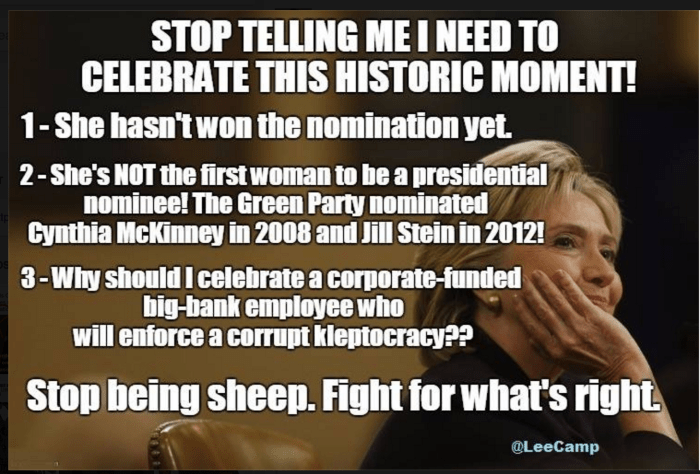
Exhibit #1 no why they’re pissed and are deeper than the media coverage of them:

Screenshot 2016-06-09 07.55.16.png

  • “Stop telling me” – they’re tired of being told how to view history, how to think, how enthusiastic they need to be, or how they should have been voting all along
  • “hasn’t won the nomination yet” – a little trickier, but a lost of this is connected to the pre-California announcement by the AP that it was over, and HRC’s statement that it’s time for Sanders to shutter the operation.  Glenn Greenwald put it in better context, but I think it’s more than the naive hope that “he might win”
  • “She’s NOT the first woman” – I have trouble taking this one too seriously.  HOWEVER! Given how quickly, and inescapably, a lack of enthusiasm for HRC translates into sexism, I could see a desire to turn the tables on the Woman Card being played against them.
  • “why should I celebrate” – I think there are two things at play here:  1) HRC has come to represent the ultimate game player; 2) HRC’s connection to 2008 (which directly diminished the future prospects of many millenials) through WJC’s deregulation, her closeness to the financial sector, and some blaming the victim in the sub-prime mortgage crisis; and 3) possibly, a higher-minded notion of the women they want to celebrate.
  • “corrupt kleptocracy” – doesn’t need annotation, post-Occupy
  • “Stop being sheep.  Fight” – not sure what’s next, Occupy, Obama, Sanders were all worthy places to put energy and educate themselves and now their outlet is HRC or Trump.

This meme comes from Lee Camp, the host of Redacted Tonight, and an aspiring youTube heir to the Daily Show tradition.  I personally find him charming, often funny, but burdened by his anger.  But this is an age where rage must be served up with humor.  And as the outrage gets stronger, Jon Stewart’s menchsy approach might not cut it.  Witness the John Oliver cadence: spend two minutes getting really, authentically angry about a surprisingly sober analysis, and then riff on a reach-around joke for a minute to defuse the tension, repeat throughout the piece.

But the point with the video is an assertion of independence – “our dismissing their dissent on that basis [youth0 is one of their issues” and this technically accurate but arguably wrong argument serves that purpose.

What’s next for me

In response to Mister Jones’s question about what’s next for this blog, I’ll share what’s next for me now that my preferred candidate is figuring out what’s next for him (much less interesting than the future of the blog, to be sure, but I can see why he cares).

My headspace includes the following thoughts:

  1. Since 1988, with the exception of 2008 and 2012, all of my presidential votes have been against the Repbulican party.  I’ve accepted other people’s math that I can’t vote for what I want, that I must defeat the enemy.  I’m doing it again, but I want more.
  2. Sanders 2016 has proven:  1) you can succeed in national campaigns with many small donations from human beings; 2) people will come out in shocking numbers for political ideas and politicians that conventional wisdom declares DOA; 3) you can fill venue after venue after venue with shocking numbers – even if you haven’t flown in on a private jet funded by a reality TV show.
  3. Key issues, like the $15 minimum wage, can become national requirements for a democratic candidate with enough local, grassroots pressure.
  4. Local power and popular pressure can move national candidates (and maybe keep them there).
  5. FDR’s challenge to Sidney Hillman – “that’s a great idea, now go out and make me do it” – has renewed importance.
  6. Mass media and advertising in presidential elections no longer holds the sway it did during the heydays.
  7. Partly because of the declining efficacy of advertising, money in general seems to be holding less sway over voting and voters, even as it increases its power over elected officials.
  8. “The revolutionaries are those who know when power is lying in the street and when they can pick it up. Armed uprising by itself has never yet led to revolution.” (I’ll use the Arendt version rather than Lenin. Both are inferior to John Hodgman’s keen observations about the subject, but I haven’t read enough of his work.)  We need to make sure there’s someone with resources (people rather than money) to pick up the anger in the street.

So, I’m focusing on 2018 in two ways:  1) The Personal Democracy Forum, a conference about technology, organizing, and campaigns; 2) the pipeline and things like Brand New Congress, both of which are identifying, and cultivating, progressive candidates at the local, state, and Congressional level.  All of these initiatives are trying to work alongside, with, and occasionally the existing two parties, but are focused on helping develop progressive candidacies outside of the existing party systems.

I think this is relevant to the Inn – I put in the bullets up top to justify it as an observational post.  And I think the pipeline issue has been hinted at by CVFD in multiple posts.


A different kind of exit

Most Presidential candidates, when they’ve reached the moment of defeat or futility, can simply step down and get back to their lives.  They can resume being Senators, enjoy being rich again, start getting rich, get out of debt and then into the private sector, or go onto TV and wait for phone calls about appointments.

But what does a Bernie Sanders do?  He’s a combination of Jed Bartlett (“I’ll give some speeches and then we’ll all go home”) and Stackhouse from The West Wing:  he never expected the kind of success he attained, and built a movement that was bigger (and angrier) than anyone could have predicted.  He’s built a coalition that is demographically and philosophically different from but maddeningly close to the Democrat mainstream (or many people’s memories of it) and the campaign has unleashed (or scaled) a form of political energy not seen in decades.

An exit now is more than stepping out of the race for the good of the party – it’s stepping out of the race while maintaining momentum.  It’s being an alternative voice to a deeply conflicted party while supporting its deeply flawed candidate.  It’s being a Senator while figuring out how to stoke and transfer the momentum of a movement that not everyone likes.  It’s straddling the anger and idealism, the realpolitik and the vision.

Not at all easy.  I hope he is as deft about this as he has been at his best moments.

Unproductively Studying Productivity

Having a hard time pulling myself away from productivity conversations on the webs.  A recent report from the President’s Council of Economic Advisors indicated that if the last 40 years had shown productivity gains similar to those made in the previous 40 years, the average US household would be $30,000 richer.  While the measure is being hotly debated, US citizens seem to have made up their minds:

the last time a majority of Americans rated their own financial condition as “good or excellent” was 2005. Gallup finds that the last time most Americans were satisfied with the way things were going in the country was 2004. The last time Americans were confident that their children’s lives would be better than their own was 2001.

We’ve been hearing some of this since the 90s.  The first reported Generation X  – born in 1965 or after  – was notable because it wasn’t likely to experience the material comforts of its parents.  Subsequent Gen Xes – the start year moved until we got to Y and Z – have had the same fate.  Still, there’s something grim about millions of people going to the polling booths, knowing that a majority of them know they’re screwed, and that only one person is saying it.