Finding the front of the march

There’s a scene in The West Wing (I know, I can’t help it) where pollster Joey Lucas is debating WH Deputy Chief of Staff Josh Lyman on the meaning of some polling numbers.  Lyman cautions that continued negatives on gun control means they have to “dial down the gun rhetoric.”  Lucas, the woman with the numbers, goes a different interpretive route:

You say that these numbers mean dial it down. I say they mean dial it up. You
haven’t gotten through. There are people you haven’t persuaded yet. These numbers mean dial it up. Otherwise you’re like the French radical watching the crowd run by and saying “There go my people, I must find out where they are going so I can lead them.”

It feels corny to quote The West Wing, but I can’t find the original story after a hard thirty seconds of searching, so I’ll go with a fantasy text as my source.(*)

We are now watching the Old Guard of the Democratic party play the part of the French radical.  They are going to have to run to find the front of the march so they can lead on progressive issues.  In fact, they’re going to have to run hard, because they’re racing  conservative evangelicals to lead in that space.

Two remarkable things about the election earlier this month and relevant here are:  1) the passage of minimum wage bills in Arkansas and Missouri; and 2) the restoration of voting rights to convicted felons in Florida.  There were, of course, also good outcomes on Medicare, but they were less surprising.  Minimum wage raises in two red states, one of which is “right to work” (AR) and one where “right to work” was defeated after a heavily fought battle (MO), is a pretty significant outcome.  Unions are weak in both states, Democrats can’t be bothered to fight in most of their voting districts – and yet, people are taking actions that look like distinctly blue states and cities.

More interesting, though, is the restoration of voting rights to convicted felons in Florida.  The state constitutional amendment was passed by 65% of Florida voters.  Sixty-five percent.  Think of that.  A state that seems likely to vote 50.1% to 49.9% on drowning puppies, voted overwhelmingly to restore voting rights – to convicted felons!

On neither of these issues did Hillary Clinton take stands that could be called leadership.  Her strongest statement on the Fight for $15 was that she wouldn’t veto a bill for a $15 minimum wage if Congress passed one.  And I’ll spare you guys listening to me talk about the hypocrisy of Clintonists on racial justice and the New Jim Crow.

What we’re continuing to see – through various flip districts, campaigns that ran outside of direct DNC management, or grassroots action is an emerging consensus in support of issues Democrats typically feel a need to dial down.  People are marching ahead on issues that the Democratic consulting and political operative class consider to be losers.

And today we find out that evangelical leaders are planning to show their softer side and take up several classically Democratic issues.  Ralph Reed, of the Freedom and Faith Coalition, responding to the harsh turn of public opinion against what is now seen as the evangelical agenda, says [emphasis mine]:

“Social conservatives need to maximize turnout from the base and expand the map by stressing the softer side of the faith agenda: education reform, immigration and criminal justice reform, and anti-poverty measures.”

Of course, not all evangelicals are moving in that direction.  In fact, some are doubling down on the punitive fundamentals.  Tony Perkins of the Family Research Council, has an interesting Aristotle meets Goldwater phrasing for his moral strategy moving forward:

Very few people anymore are in the middle. Barack Obama brought us to this point more quickly because of the extreme policies that he pushed. Trump, with the support of evangelicals, has worked to move the pendulum back.

In other words, extremism in the face of extremism isn’t extremism, it’s a way back to a balanced center.

Despite the internal disagreement, it’s clear that very serious players in the most hardened corners of the right are moving into classic, DFL-style Democratic territory.  Education, criminal justice reform (which in the age of the New Jim Crow largely means racial justice), and anti-poverty work are supposed to be Dem issues.  But evangelicals see that as winnable territory.

Within the Democratic party, there’s a strange fight happening around the Green New Deal.  The Green New Deal is a combination program of infrastructure, public spending, jobs, and climate change fix – something we might have considered Democratic Party 101 in the not so distant past. And yet, the Congressional Progressive Caucus is rallying  troops in a fight to get these issues onto Nancy Pelosi’s to-do list. (I realize some of this is theater.  And it’s definitely smart politics to pressure Pelosi.  That’ll make it easier for Pelosi to deal with other wings of the party and the broader donor base.  Still, it’s weird to watch, especially as 45* continues to woo working folks and unions with hopes of an infrastructure bill.)

45* is already getting out in front of the Republican black and latinx voter problem with announcement of prison sentencing reform, taking a big swing at the Democrats’ already fairly weak claim on being the party of racial justice.  Evangelicals are getting ready to take on the mantle of fixing our schools, fighting poverty, and economic justice.

And now we get to watch Pelosi, Schumer, and the DNC in a foot race against Ralph Reed to the front of the crowd – to try and lead the people who have been headed in the direction Democrats should have been marching all along.


(*) An extra thirty seconds indicates that this is one of those quotes will wind up attributing to all sorts of people, including Alexandre Auguste Ledru-Rollin, a forgotten French radical of the 1848 era.  The line attributed to him, by some, is “There go the people. I must follow them, for I am their leader.”

Ways we could have known it was coming

Just popping in to record something.  We’ve had discussions about voter identity formation and the ways in which it depends on non-policy intangibles like trust and relatability.  We’ve also had discussions about the ways in which the job of POTUS has been demystified to the point where voters might think vision and force of will are all that are needed.  Early signs that Trump could build a movement and squeak out an electoral win.

Today, someone told me to “go back to [my] latte” when I questioned whether the pack of billionaires Trump is appointing constitutes draining the swamp.  The latte reference, combined with “jagoff” gave me high school flashbacks of being mocked for books, playing the trumpet, D&D, and generally being a ‘fag’.  “Fag” was acceptable then and is useful today to describe the ways in which people can have contempt for your manhood without suggesting you’re gay, or even caring that you’re gay.  (Watch Denis Leary’s Rescue Me episodes where they come to terms with someone who is gay in their firehouse.  They do the commendable work of showing how men can be OK with homosexuality as well as their queasiness about it, but still get to use fag, fairy, and gay to question someone’s underlying masculinity.) Still it’s hard to use “fag” without the needed disclaimers, so I’ll do it sparingly- when I think it’s the clear subtext.  Looking back over various interactions with friends and acquaintances since Trump’s ‘win’, I’ve seen the us verus them undertones:   about the nature of my professional work, references to my hands being soft or used at all, and my consumption choices – all in the service of calling me a fag in some way.

Which brought me back to two Budweiser Super Bowl Ads. If I were man enough to watch the Super Bowl (I treat it as a day off to do my own shit and wander the world free of crowds while people huddle in front of their TVs), I might have been much less complacent about Trump.

The first was for the 2015 Super Bowl, mocking the craft beer world and its devotees:

I’ve spent some time in my career close to, some would force me to say actually in, advertising.  I’ve learned that the best ads are lovingly crafted with an insane attention to detail.  Advertising creatives are masters at loading every frame of a spot with cultural meaning.  Ads like this, which carry such powerful cultural force, should be Zaprudered with every frame under the microscope.  But I don’t have that kind of time, so I will share some quick observations:

  • the people drinking Bud are in the presence of hot women in tight t-shirts, the fags drinking craft beer only hang out with their equally wussy guy friends
  • the hot women who bring the men beers have strong arms and tattoos (probably from yoga, but the illusion is clear)
  • the guys do faggy things with their beers like sniff them and hold them up to the light like they were drinking fucking wine or something
  • not only do they require glasses for their sipping and tasting, they even have fancy boards to serve their sips
  • they don’t have ‘facial hair’ per se as men do, they have ironic mustaches and side burns cut and waxed into shapes with names and which require “product”
  • and they are soft, doughy, fuss buttons
  • they are other, they are THEM

Within the industry, the 2015 spot got some static from craft beer makers, but it was generally considered a success.  Interestingly, though, Budweiser’s 2016 spot was titled and themed #Notbackingdown.  The static in 2015 was minor and registered at about 1,000,000th of the impact of a Super Bowl spot, but in 2016, the brand played the role of persecuted regular guy.  This contrived persecution allowed Bud to stand defiantly against an enemy that didn’t really exist.  Where have we seen that before?

The second spot didn’t go after fags as blatantly as the first one, but there’s a clear undercurrent of real men and the women who love them.  (The link works as of this posting, ignore the 50s-era dead signal signal.)


  • “Not for everyone” – again with the note of us and them, but with the interesting Silent Majority inversion – even though we know we are everyone, we will not be made less so by THEM
  • hot women still dig the Bud drinker and are even charmed by the grumpy confused old man who wonders how the fuck this piece of fruit got in his beer
  • fruit cup, clever way of talking about beer problems while calling the drinkers fags
  • Not imported: is there a more powerful symbol of globalization and the new economy than container ships?
  • “Not soft” doesn’t need unpacking.  But if you Zapruder this spot, you’ll see hard hands swinging kegs and cases, and men operating seriously big fucking equipment, not playing with their beer making kits from Whole Foods. No freaking way these guys use product!
  • Rock and Roll – cymbals, guitar chords, head-banging – no techno, synth, folk, girls with guitars, ecstasy raves, alt-rock wine-sipping, or turntablist shit here.

We should have seen it.  Donald Trump would totally have approved this ad.


Worth a share

and a way to save it.  I’ve gotten no small number of “happy now asshole?” notes for my continued desire to say something more rich than “racist misogynist xenophobic asshole” to describe the 59,000,000+ citizens who voted for Trump last night.  But I also got an amazing note from a woman with whom I went to HS in Latrobe, PA.  It was in FB messenger so forgive run-ons and the lack of paragraphs.

“Kip, I think that it must be hard living in NYC to understand the trump voter. Must be like living in a liberal bubble. The racism with Trump is a recurring theme in your posts. I agree it is disturbing that he has such hateful followers and thanks to him they feel emboldened to crawl out from under their slimy rocks. I cast my vote for hilary. Last time I voted for a democrat was gore in 2000. In the past few weeks, republicans who I thought were not voting for trump decided that in the end just could not vote for hilary. Most had a specific issue or two that made them look past his disgusting faults – taxes, SCOTUS, national security, late term abortion. None of them want a ban on Muslims. All feel immigration is an essential part of who we are and want a path to citizenship. None of these people are racist. Outside of your posts, I have heard no one talk of racism. I agree it was an issue for me, though. I was in many an argument with a white supremacist on twitter (my husband is a Jew, my daughter dating a black boy). All these Republicans believe he is awful but that hilary is worse. Because they did not like either candidate they voted on issues. Now, I don’t think trump has a stance on any issue – or he has about 5 on every issue. Nor do I trust that he will do anything he says he will. My print is that outside of NYC and other big liberal cities, the racism was never much of an issue . I work with several black men who were voting for trump. When I asked why, they stated economy. To finally get to my point, don’t worry about your white brothers, the same racists that have been there are still there (just louder), 99% of his voters aren’t racist – they had other issues on their mind. And not being racist themselves, I don’t think they believe it is a huge problem with others (right or wrong). My husband shocked me when he voted for trump. He said we can’t afford another 4 years of Obama. The last 8 years we’ve been taxes to death. Due to economy, he’s had 3 pay cuts, no bonuses in past 8 years. He is finally back to his 2008 salary now. We are paying $84,000 a year for 2 kids in college. 6 more years of this to go (sophomore in collegw and my youngest is a senior in HS). Oldest graduates from clemson this year and we start paying for medical school as well. Taxes were his only issue when he voted. He is no racist. I adore your passion, your love of your fellow human beings and wonderful heart. But your liberal friends have to realize that not everyone has the luxury to vote based on issues like that. Remember Michael Moore? This was the big F-you. Let’s just pray we don’t pay for this in such a way that we can’t recover in the next presidency

Tell.your friends that this is hiw common america thinks of NYC liberals. Elitist. Holier than though. Smarter and know better than others. Listen to no one else. If your friends want to know how the rest of America views them


Tomorrow…

A few months back, I posted the Richard Rorty quote below.  This morning I circulated it to a dozen friends who voted for Trump with the question: “does this resonate for people you know who support Trump”.  I haven’t heard back from a few, but the 7 who have responded, said “Yes, except for the last paragraph” in one form or another.

members of labor unions, and unorganized unskilled workers, will sooner or later realize that their government is not even trying to prevent wages from sinking or to prevent jobs from being exported. Around the same time, they will realize that suburban white-collar workers—themselves desperately afraid of being downsized—are not going to let themselves be taxed to provide social benefits for anyone else.

At that point, something will crack. The nonsuburban electorate will decide that the system has failed and start looking around for a strongman to vote for—someone willing to assure them that, once he is elected, the smug bureaucrats, tricky lawyers, overpaid bond salesmen, and postmodernist professors will no longer be calling the shots….

One thing that is very likely to happen is that the gains made in the past forty years by black and brown Americans, and by homosexuals, will be wiped out. Jocular contempt for women will come back into fashion…. All the resentment which badly educated Americans feel about having their manners dictated to them by college graduates will find an outlet.

Since we’re learning that political conversations no longer have to begin and end with data (and that data might be neither when it comes to understanding voter identity and movement formation), I’m not going to apologize for it being a small sample.

I’m in mourning, of course.  And I’m scared – more for my friends who aren’t white or who live outside of Capitol City (NYC is mine), but a little for my family too.  But that’s done.  I used to visit Mother Jones’s grave every time I drove to Decatur, IL and it’s her that’s my kick in the ass: “Pray for the dead, fight like hell for the living.”

I present the Rorty quote not as a provocation or a defense but more as a “bug description.”  When you have a software defect or bug, your first task is to describe it accurately, see what steps led to it, and then work on a fix.  One bug description is based on character flaw: “People are racist and misogynist and generally assholes.”  I’m not sure that has explanatory power as it leaves us with the question of where did this racism come from?  Why is it spiking when there are indicators – in polls, popular culture, and some voting patterns – that racism is declining?  Why did it happen so quickly?

More important to me is that the character flaw explanation has no viable solution:  liberals are quite skilled at lecturing and hectoring people about their un-evolved attitudes and social media has made them as efficient in hitting people with that message as one can be (unless you actually wanted to talk to a person).  But despite their skill and many channels for conveying these lectures, it doesn’t seem to be working.

The Rorty quote offers a different bug report:  “people have decided the system has failed them at a fundamental level and are turning to any alternative that looks like not the system.”  (This is paragraph one and two, and with a less specific paragraph three, one in which it might not have been the strongman, it might have been a Democratic Socialist, or a preacher, or . . . ).

I’m going to work on that bug and highlight a few things that come out of taking that bug seriously:

  • we have to turn our attention from “why didn’t they vote for us” to “why can’t we earn their votes when it should be so easy?”
  • we need to recognize that people’s lives as citizen aren’t made up exclusivelyof policy comparisons and resumes but are bounded by stories,  community, and a sense of trust and identity.
  • we’ve had strong electoral outcomes when the country was considerably less educated and intelligent, so we may need to re-frame that argument.
  • that said, we’ve lost the ability as a polis to have conversations around evidence, causal effects.
  • we no longer have a clear sense of citizens who must work on “e pluribus unum” – on either or any side of the debate.

For too long, we’ve watched Dems actively target a knowledge worker, pro-business, white collar base while hoping union, working, black and latino folks will stick with them.  Each time they lose, they turn to better get out the vote efforts.  With the exception of Obama’s two elections, they rarely acknowledge that they need to bring people back in – earn votes (insert the full text of “cling to their guns” for the 100th time on this blog).  The biggest surprise for me last night was how much these rural, small town, small city areas got out the votes and defeated the polling predictions.  We thought having no ground game would kill Trump – turns out he didn’t need one.  You don’t need to get out votes when people really, really want to win.  However tragic and misguided, he earned their votes – getting mocked and abused while acting like their friend, risking social ostracism in Capitol City because he liked them more – and they came out.

Time to fight for the living . . . and to start with the long hard work of resisting the urge to improve their manners and focus instead on earning their trust back.


Continuing the Trump-Liberal conversation

… but on a different vector.  This started as a comment on my post about liberals playing the race card and neglecting WWCs (and thus having their hands dirty in the “where did Trump come from” converation).  It  got very long while at the same time seeming to unpack issues raised by CVFD and Barry.  So a post .. .

The Intercept ran a piece yesterday unpacking some polling data about WWC support for Trump.   The headline “The Great White Hype:  No One is Energizing the White Working Class, not Even Donald Trump” doesn’t reflect the data at the center of the piece.  The data shows

a reversal [of growing WWC support] from earlier in the summer, when Trump’s support among the group was in the 60s, higher than Romney’s, though not by leaps and bounds.

Trump’s support from WWC – defined in questionable ways (more on that below) – was in the high 60s before the convention, and has dropped to 49% in recent weeks.

These data only says that Trump’s support from the WWC is on the decline, and probably a significant one.  It doesn’t say that he isn’t energizing WWC or that he never did.

Still, it adds to our conversations elsewhere about what makes these people tick.  The data in the story offers a couple hypotheses:

  1. that there is an overlap between Sanders’s WWC message and Trump’s and that voters are leaving Trump and going to Dems (per CVFD’s question);
  2. primary behavior didn’t really tell us anything about the substance of the support for Trump (because, as the article notes, it was such a small percentage of voters in a serial fish bowl campaign mode)
  3. Trump’s popularity was broader and deeper than WWC, and now even more mysterious

Those are hypotheses only.  The data only shows some correlations and we probably can’t prove anything for a while.

Or it may be hard to prove anything at all.  The article also highlights some tricky data/polling issues:

  1. What is WWC – polls have fairly thin definitions of WWC – lower education levels, income levels, geographic overlay.  Sounds straightforward, but what about office workers, people with college degrees with working class incomes, people on the border and in fear of slipping.  This is classic Orwell territory, and worthy of more conversation and thinking, but I’ll just quote John Cleese playing Robin Hood in Time Bandits “The poor are going to be absolutely thrilled!  Have you met the poor?  … Oh you must meet them.  I’m sure you’ll like them.  Of course, they haven’t got two pennies to rub together but that’s because they’re poor.” Class words cover a lot of complexity.
  2. the notion of base is tricky  – it’s never that only one segment makes a candidate, or that there is a finite set of attitudes that shape that support
  3. the exceptional nature of 2016 – and for that matter all elections since and including 2008.  All of them are made exceptional, or at least discontinuous from previous elections and polling environments because of the financial crisis, and the various effects of the internet (microfragmentation of communities, disintermediation of experts, fund-raising for example).  The article goes back to 1992, reminding us that we’re 24 years into independent rumblings, starting with Perot, continuing with Nader, always in the air with Trump and Sanders and now with Gary Johnson (I can’t talk seriously about Jill Stein, I know that’s wrong, but I can’t.)
  4. connections between what a candidates say and why people vote for them – there is a straight causal line drawn between candidate sound bites and votes.  In TV coverage, Trump talks about the wall, mocks people, rails against PC by being offensive.  When people vote for him, the only causal link we have is that Trump voters love those things.  That’s like saying I support flip-flopping on DOMA, the Iraq war, politicians who are super tight with Wall Street, resisting the minimum wage, resisting the New Glass Steagal, TPP because I’m voting for HRC.  James Fallows, Thomas Frank and others (I’ll try and add the links) continually point out that:  1) Trump talks a lot about jobs, trade, and economic issues for the rest of his speeches; 2) that Trump supporters don’t always gravitate to the xenophobia but will never vote for HRC, will never vote Dem, want the system messed with, are willing to roll the dice; and 3) he’s the Republican nominee, that’s who they vote for.  Polling and issue mapping don’t capture this complex process of political identity building, answers to pollsters, or final votes.  They hint at it and provide hypotheses, but that’s as far as we can go with certainty.
  5. self-awareness about polling – fielding, following, reading polls has always had a box score feel to it, but now it feels national.  It seems like everyone talks about them and has enough of an understanding to manage a critique of them (see the revived “skewed poll” debate).  Trump refers to “nice polls” that show him doing well, questions the bias of those that don’t.  This is an edge argument, but with all this awareness of how polls play into politics, do we really understand what someone is doing when they answer questions?  We regularly entertain the notion that people might not be saying they support Trump because they don’t want to appear racist to the poll-taker – why can’t people answer questions in order to buck the trend, lodge a protest vote, which finally comes to
  6. the notion of likely in polls – likely voters, likely to vote for a party – these are all concepts that have to standardized over time and which are based partly on self-identification and validated by historic behaviors.  As historic behaviors become less relevant (Trump’s strategy is to reach out to “low propensity voters” and people are aware of the impact of the surveys they’re participating in, we have a lot of threads to unpack.

Good thing there’s fivethirtyeight.


Apologies CVFD and Mister Jones – the only link I could be bothered to track down was the John Cleese clip.  I’m really dragging us down.


Hey, liberal, are *you* supporting Trump, too?

Liberals and Democrats in my filter bubble – IRL, in the media, on social media – are spending a lot of time blaming people for Trump.  Racist Republican leaders, strategists, funders, and voters get the most blame.  There’s also a fairly loud contingent that want to (pre-emptively) blame Sanders supporters, independents, and third party folks for Trump and his continued existence.  But the blame is always other people.

But did we liberals and Democrats have anything to do with Trump’s rise?

Ask yourself the following questions:

  1. Did you sit quietly by while Bill Clinton did his dog whistle race politicking?  While Hillary talked about super-predators?  Yes?  Then you promoted racism in politics.  Not as bluntly and crudely as Trump, but you helped legitimize the environment of racial anxiety he’s tapping into now.
  2. Did you protest the crime and welfare reform bills that Bill, Hillary, Schumer and others supported and brag about to this day?  If not, you stood idly by while millions of black families were torn apart and millions of children were pushed into poverty – by laws that we knew at the time were biased.
  3. Do you laugh at and make jokes about the intelligence of Trump and Republican voters?  If so, then, in addition to belittling people with your intellectual privilege, you antagonize and make sure they will never feel at home in your party.  You give Republicans proof points that Democrats aren’t really for the people.  You make us out to be such elite elitists that a billionaire can call us elitists and get cheers.  Nobody joins causes or groups that insult them – so when you mock and belittle them, you shut the door to our movement, leaving them with only demagogues to turn to.
  4. Do you say sadly, “I just don’t understand how they can. . . ” without really trying to?   Yeah?  Well that’s not being thoughtful and sad or hurting in an enlightened way.  That’s just another way of being elitist.  See question #3. [Question 4 A do you wish people would read Toni Morrison and Coates and Malcolm X, but refuse to read Hillbilly Elegy or the like because “oh, I don’t want to hear it”? Update: Below are a couple more worthwhile links.]
  5. Do you know what the median income is in the United States?  If not, then you’re probably unaware of the key economic reality of Americans outside of your filter bubble.  It’s $51,000 which is very low just about anywhere – not enough to save, own a home, build equity, pay student loans, send kids to college.  It’s been stagnant for years, too, so there are generations of working folks who haven’t had the American dream, no matter how they voted.  Not until Obama or Sanders has the party really owned income inequality as an issue in the last 30+ years.  So all that resentment we’re hearing now?  Kind of on us, too.
  6. Talking to a Trump supporter, would you be able to name five specific things that Hillary or the Democrats have done to help the economic security of families below the median income?  SCOTUS doesn’t count.  Neither does “well, it’s obvious” – Name five specific things (specific like the way DOMA prevented same sex marriages and then overturning DOMA-style laws allowed it).  Almost nobody can think of five, but once you do, present them to a Trump supporter and see if you or the person you’re talking to believes it.
  7. Have you spoken to a person with kids who is below the median income who isn’t your child’s caretaker, housekeeper, doorman, or gardener etc. about what their lives will look like ten years from now?
  8. Do you know the minimum wage in your state?  Even if you don’t know the amount, you probably know that the amount * 52 weeks * 8 hours is well below the poverty level.  What have Dems done on that front?  How many times have you made phone calls or pinged your Congressional Representative to fix it?  Do you personally pay your domestic help sufficiently above minimum wage to keep him or her above the poverty line?  Are you contributing to their FICA (which also protects them from disability or their kids from loss of life)?
  9. Do you hate stereotypes of people, but feel comfortable labeling the 10 million people who voted for Trump as racists? If yes, is that because you’re so smart,  you can tell what’s in the souls of ten million people without meeting them? That’s kind of messed up isn’t it – your stereotypes work but others don’t?  Are you sure you’re the party of love, understanding and inclusion?

Liberals and Democrats need to take a look at whether they’ve truly been an alternative to the Republican Party and whether or not they’re culpable, too, in creating a body politic where a Trump thrives.  As BHO famously reminded us:

You go into these small towns in Pennsylvania and, like a lot of small towns in the Midwest, the jobs have been gone now for 25 years and nothing’s replaced them. And they fell through the Clinton administration, and the Bush administration, and each successive administration has said that somehow these communities are gonna regenerate and they have not.

In Obama’s narrative, Democrats are no more entitled to the votes of these folks than Republicans are.  Worse, when Democrats engage in memes mocking their intelligence and education, tut-tutting why they don’t get it, reducing them to their racial anxieties and prejudices, they make very clear: “not only do we not intend to help you, we find you distasteful.”  (Obama famously mis-spoke the rest of this otherwise sympathetic analysis with “cling to their guns”, but he was calling out the same phenomenon.)

It’s easy to want Trump voters to just go away and take all their distasteful, unevolved behavior with them.  But that won’t happen no matter how soundly HRC beats him.  If liberals and Dems aren’t going to connect with them, are unwilling to hear their pains or heed their concerns, they’ll come back even more angry.  Remember how we were all terrified when Trump might lose because Rubio and Cruz would be worse – more electable, more effective, less unhinged?  That’s what our next demagogue will be – smoother and more effective than Trump, and we’ll have done nothing to get right with the disaffected.

=====================

More reading:

The Politics of Resentment” an article summarizing the research of a professor who repeatedly visits every county in Wisconsin to understand the voting divide and contradictory behavior.  There’s also a book.  Short version:  some people start their political identity building with a simple question:  “are you with us or are you with them?”

Deer Hunting With Jesus:  Notes from America’s Class War I haven’t read it, only downloaded it, but many find it akin, even superior to Hillbilly Elegy.  

Winner Take All Politics” Bill Moyers interviews the authors of the book by the same name.  Covers a lot of ground, but for this post, it’s also about the destruction, cooptation, or dilution of intermediating groups like unions and political parties.

White Trash – the link is to an interview with the author.


#whytheylose

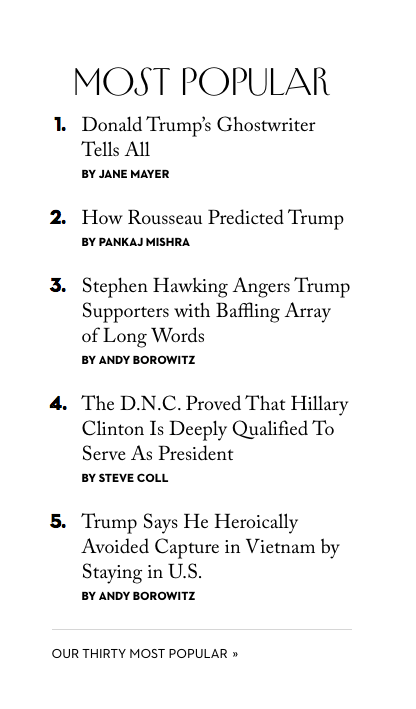
On the web page of a decent article about the state of [a certain segment of] white Christians in the New Yorker, this related article box bubbled up:

Screenshot 2016-07-31 08.44.55
After reading this almost not-condescending article about white Christians, you might want to check out these.  


My reasons for latching onto it are pretty predictable and obvious – smug, douchenozzles insult and ‘splain till they’re as red in the face as the Pinot they’re drinking and then wonder why they aren’t getting more votes.

A friend went a little deeper and ticked it off neatly:

  1. Gossip, but on our side, so it’s cool
  2. Ego-self-stroking
  3. Mockery
  4. Because this article might prove it once and for all (or, let’s keep talking to ourselves)
  5. Mockery

The best part of this whole experience, though, was actually clicking into the Rousseau article, wherein you’ll find the best self-parodying New Yorker-ese ever seen and which can not be topped:

No Enlightenment thinker observing our current predicament from the afterlife would be able to say “I told you so” as confidently as Jean-Jacques Rousseau, an awkward and prickly autodidact from Geneva, who was memorably described by Isaiah Berlin as the “greatest militant lowbrow in history.”

It’s like this writer actually hangs out with us!  How often have we had this very argument?  “Which Enlightenment thinker is most entitled to say I told you so?”  “Which of the pre-Socratics can claim, if heeded, to be the most likely anti-dote of Trump?” “Which of Aquinas’s followers opened the door for modern-day evangelicals to claim the mantle of Christianity?”

Doubling down on dumbing down on data

Did you hear the news?  17 million morons voted to leave the E.U. then in open-mouthed stupidity wandered back to their computers to find out what they just voted for.  It’s true, because NPR + a graph proves it.

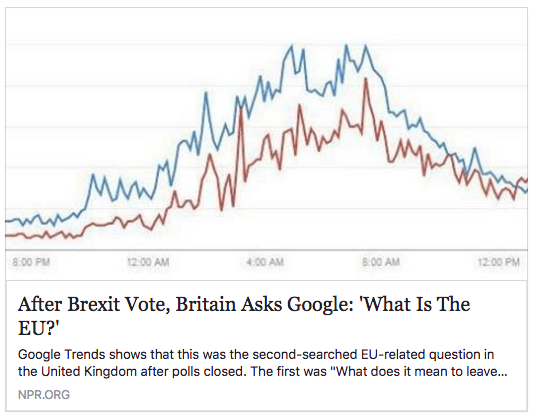
NPR should know better. They ran a story titled “After Brexit Vote, Britain Asks Google:  ‘What Is The EU?'”  It went viral on social media – with the predictable tut-tut, SMH, can you believe these people curations – and everywhere it was posted, you got the thumbnail:

Screenshot 2016-06-25 10.27.54

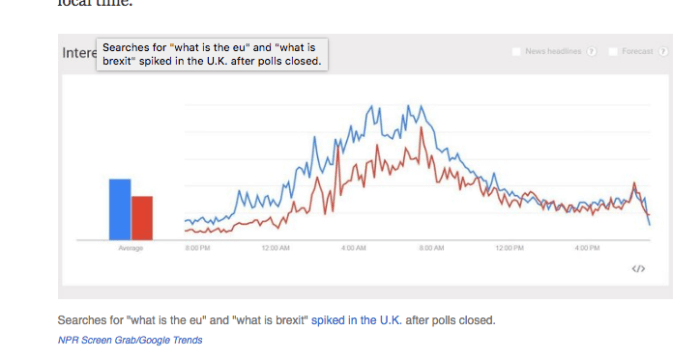
This is where data visualization needs a modern day George Orwell to kick some ass about the vicious cycle of sloppy visualizations and sloppy thinking.  By the way, if you’re inclined to say, “crops are always problematic, but they captured the story”, here’s the actual graph in the story:

Screenshot 2016-06-25 10.30.13

Once you’re done gasping at the steep upward climb, you might notice that the chart has no labels on the Y-axis, and no gauge for the volumes being measured.  Typically, Google Trends data is about the percentage of all searches that this search represents.  Just as typically, these trends are fractions of a percent – entire nations rarely run to the keyboard and run the same searches.  But we can’t know, because we were just shown graph lines.

What we do “know” from the “reporting” is that

“Though of course searches for these questions were dwarfed by the general interest in “Brexit results,” the question “what is the EU” spiked in popularity across all parts of the U.K., in this order: Northern Ireland, Wales, England, Scotland.”

This makes the reporting even shoddier:  the original numbers are small in comparison to these other numbers (which we also won’t quantify for you), but they definitely represent popularity spikes, and our keen political analysis formula is:

“Spike in popularity” == national mindset == gauge of political literacy

Therefore, our Breitbart-worthy headline, brought to you by the good people who sent you that coffee mug over which you just did that spit take.

What a terrible story and from NPR of all places.  I can only guess it’s targeted at people who need to freak out in their political microclimates.  Still, how is it possible, in the age of data literacy, that a real news outlet could run graphs without scale or labels on the Y-Axis? Or that millions of people could post it as if it proved anything?

 C’mon. Next time, keep my totebag and use the savings as an offset against the lost clickbait revenue.